
When Nobody Owns the Whole Process
The Cost of Complexity – Part 6
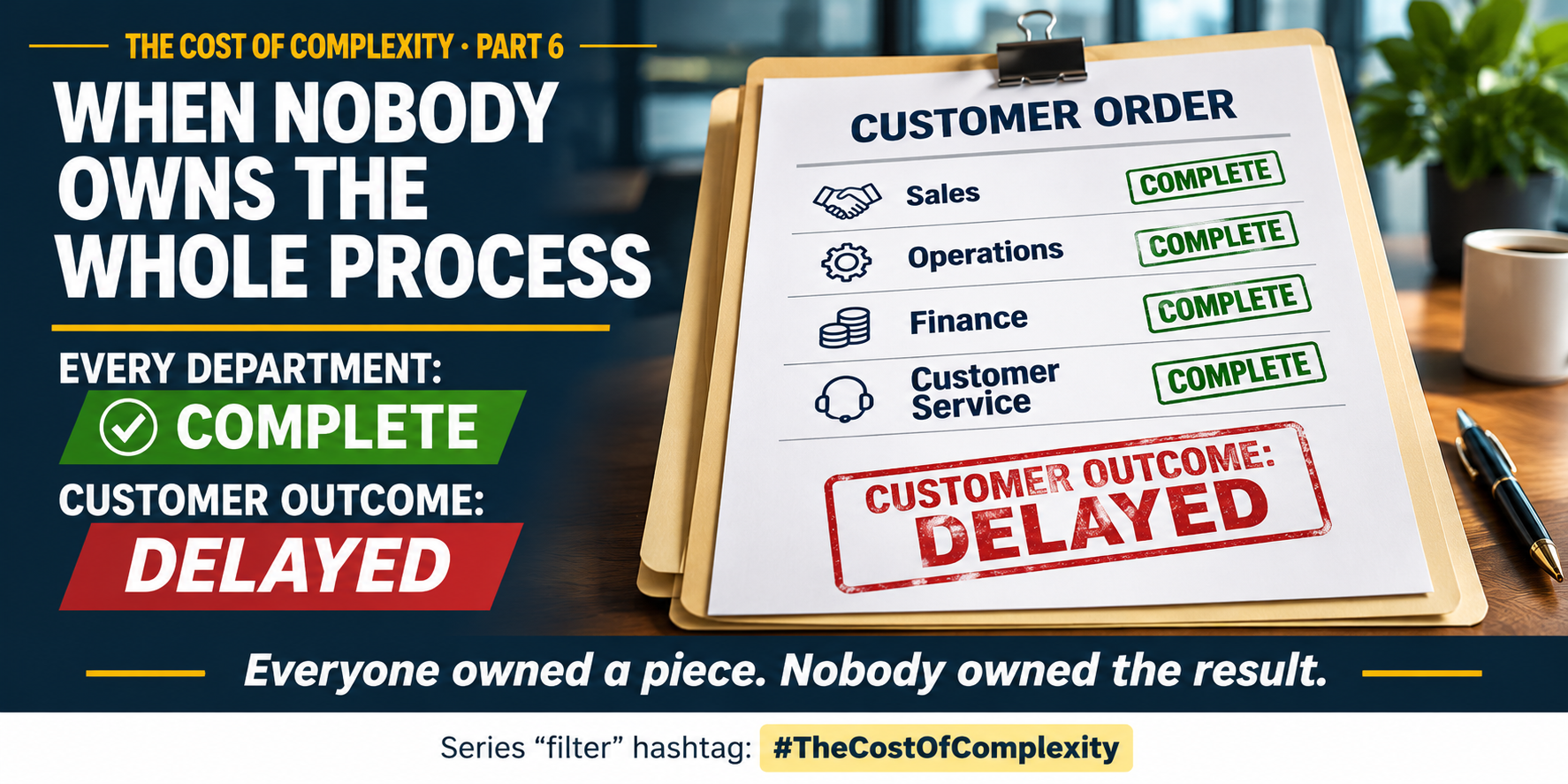
Sales did its job. Operations did its job. Finance did its job.
So why was the customer still waiting?
The order was entered correctly.
The work was scheduled.
The invoice was prepared.
Every department followed its procedures.
Yet the customer experienced delays, conflicting information, and repeated requests for updates.
When leadership investigated, each department could explain what it had done – and why the problem wasn't its responsibility.
Everyone owned a piece of the process. Nobody owned the outcome.
When Departmental Success Becomes Organizational Failure
As businesses grow, they naturally develop specialized functions.
Sales focuses on generating revenue.
Operations focuses on delivering products or services.
Finance focuses on financial accuracy and control.
Customer service focuses on responding to customers.
Specialization creates expertise and efficiency.
But as we explored in Part 1, complexity accumulates through individually reasonable decisions that can collectively make an organization harder to manage.
But it also creates boundaries.
And those boundaries can become expensive when work must move across them.
Consider a growing service company.
Sales closes a new customer agreement.
Operations receives the information but discovers that several delivery requirements weren't documented.
Finance needs clarification about the billing arrangement.
Customer service receives questions from the customer but doesn't have visibility into the commitments made during the sale.
Each department is doing its best to fulfill its responsibilities.
Yet the customer experiences one organization – not four separate departments.
The business may be organized by function, but customers experience it through processes.
The Hidden Cost of Handoffs
A handoff seems simple.
One person completes a task and passes the work to someone else.
But every handoff creates an opportunity for information to be lost, delayed, misunderstood, or reinterpreted.
The receiving department may need to clarify requirements.
A manager may need to resolve competing priorities.
Someone may need to reenter information into another system.
And when something goes wrong, additional time is spent determining where the breakdown occurred.
One handoff rarely seems significant.
But multiply those handoffs across hundreds of orders, projects, customers, or transactions, and the cumulative cost can become substantial.
The expense doesn't necessarily appear as a separate line item.
It shows up as rework, overtime, delayed billing, customer complaints, and management intervention.
The cost of a process isn't just the work performed. It's also the effort required to move that work through the organization.
When Every Department Meets Its Metrics
Here's where the problem becomes more difficult.
Imagine a company where:
- Sales meets its revenue targets.
- Operations meets its productivity targets.
- Finance meets its reporting deadlines.
- Customer service meets its response-time targets.
On paper, every department is performing.
But customers are still experiencing delays.
Projects are still exceeding budgets.
Invoices are still being disputed.
And leadership is still resolving problems that should have been prevented.
How can all those things be true?
Because departmental performance measures don't necessarily reflect end-to-end business performance.
Sales may be rewarded for closing deals without considering the cost of fulfilling unusual commitments.
As we examined in Part 3, customer exceptions can generate costs across multiple departments that aren't reflected in the original sales decision.
Operations may optimize labor utilization while creating delays elsewhere.
Finance may prioritize transaction accuracy without measuring how long billing problems remain unresolved.
Each function can optimize its own results while unintentionally making the overall process less effective.
When nobody is accountable for the complete outcome, local efficiency can produce organizational inefficiency.
More Meetings Won't Fix Missing Ownership
When processes break down between departments, the typical response is to improve coordination.
Another escalation process.
Another report.
Another approval.
Sometimes those measures are necessary.
But they can also become permanent workarounds for unclear accountability.
If nobody has responsibility for the complete process, coordination becomes everyone's job – and resolution often becomes leadership's problem.
Eventually, executives spend their time resolving conflicts between departments rather than improving the systems that create those conflicts.
The organization doesn't necessarily need more oversight.
It needs clearer ownership.
Five Questions Every Leadership Team Should Ask
To identify where fragmented accountability is creating unnecessary complexity, consider five questions.
1. What are our most important end-to-end processes?
Identify the processes that directly affect customers, profitability, cash flow, and execution.
Examples include lead-to-customer, order-to-delivery, project initiation-to-completion, and service delivery-to-payment.
2. Who owns the complete outcome?
A process owner should be accountable for overall performance, even when the work crosses several departments.
That doesn't mean performing every task or controlling every decision.
It means ensuring the process works as intended.
3. Where do handoffs create delays or rework?
Look for repeated clarifications, missing information, manual reconciliation, approval bottlenecks, and recurring escalations.
These are often signs that the process has been designed around departmental boundaries rather than the flow of work.
4. Are we measuring the process or just its components?
Departmental metrics remain important.
But leadership should also consider end-to-end measures such as cycle time, first-time accuracy, total cost to serve, customer outcomes, and time to payment.
5. Does the process owner have the authority to improve it?
Accountability without authority creates another bottleneck.
Process owners need clear decision rights, access to relevant information, and a practical mechanism for resolving cross-functional issues.
Process Ownership Doesn't Eliminate Functional Accountability
Assigning end-to-end ownership doesn't mean reorganizing the company or eliminating departmental responsibilities.
Functional leaders still manage their teams, resources, and expertise.
The process owner ensures those functions work together to deliver the intended outcome.
That distinction matters.
Without it, organizations can simply add another management layer – creating the very complexity they're trying to eliminate.
The objective is not another person who approves everything.
It's someone who can see the entire process, identify recurring breakdowns, and coordinate improvements across departmental boundaries.
Final Thought
When a customer complains, a project falls behind, or a transaction requires repeated intervention, the immediate question is often:
Which department made the mistake?
A more useful question may be:
Who is accountable for making sure the entire process works?
Because a business doesn't succeed when every department can explain why the problem belongs somewhere else.
It succeeds when people work together to deliver the outcome.
If everyone owns a piece of the process but nobody owns the result, complexity becomes part of the operating model.
Coming Next
Part 7: Simplify Without Losing Control
In the final installment of The Cost of Complexity, we'll bring the series together and examine how leaders can remove unnecessary approvals, exceptions, reporting, meetings, and handoffs – without sacrificing accountability, risk management, or performance.
Schedule a Strategy Alignment Session
Are your teams meeting their departmental objectives while customers, projects, or financial results continue to suffer?
CXO Accelerator helps leadership teams align strategy, responsibilities, decision authority, and execution across organizational boundaries.
Let's identify where unclear process ownership is creating costs, delays, and unnecessary complexity in your business.

Chris Scherer
Chris is a transformation leader with over 25 years of experience driving significant value and mitigating risks across a broad range of industries and functions. With a track record of generating more than $450 million in savings, he has excelled in both challenging and thriving environments within small businesses, mid-market firms, and Fortune 500 companies. A dual-degree graduate of Thunderbird and ESADE, Chris started his career at Arthur Andersen and progressed through roles from Corporate Audit to Global Human Resources at various Fortune 500 firms. He played a pivotal role in growing AArete, a global management consultancy, where he led initiatives that significantly reduced non-labor costs and improved compliance processes. An advocate for sustainable community initiatives, Chris was a founding member of a nonprofit focused on creating bicycle-friendly communities in New Jersey.