
The Hidden Cost of One More Meeting
The Cost of Complexity – Part 5
"Let's schedule a meeting to discuss it."
Five people receive the invitation.
The meeting lasts an hour.
Everyone agrees the issue is important.
Someone promises to follow up.
And two weeks later, the same issue appears on another meeting agenda.
Sound familiar?
The problem isn't necessarily the meeting itself.
It's that the organization has consumed another five hours of collective time without resolving the issue.
When meetings replace decisions, the business pays twice: once for the time spent and again for the work that didn't move forward.
The Meeting That Costs More Than You Think
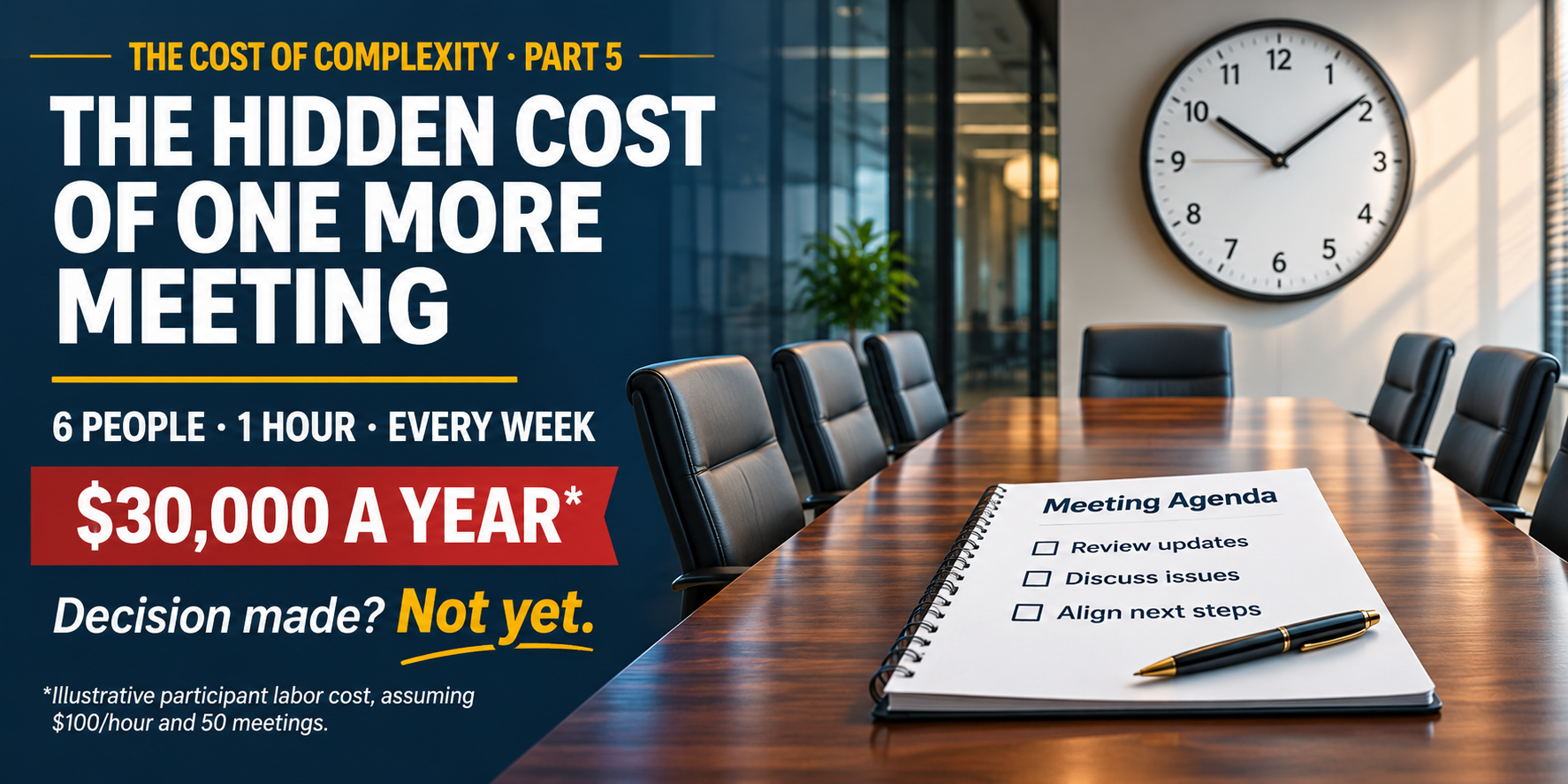
Consider a weekly management meeting involving six people.
Each participant represents a fully loaded labor cost averaging $100 per hour.
A one-hour meeting costs approximately $600 in participant time.
Over 50 weeks, that's $30,000.
And that's just one recurring meeting.
It doesn't include preparation, follow-up, travel, interruptions, or the opportunity cost of work those participants could have completed instead.
These figures are illustrative, not a claim about the average cost of meetings.
The point is simple:
Meetings consume organizational capacity, whether or not anyone tracks that expense.
And unlike a software subscription or consulting invoice, that cost rarely appears as a separate line item on the financial statements.
How One Meeting Becomes Five
Most recurring meetings begin with a legitimate purpose.
Leadership needs visibility into operations.
Sales and delivery need better coordination.
Finance needs to review performance.
Managers need to resolve competing priorities.
But when information isn't shared consistently, responsibilities are unclear, or decisions aren't made at the appropriate level, the organization often responds by adding another meeting.
A weekly leadership meeting creates departmental follow-up meetings.
Those meetings generate cross-functional coordination meetings.
Unresolved issues require escalation meetings.
And someone eventually schedules a meeting to prepare for the next leadership meeting.
Each meeting may seem reasonable on its own.
As we explored in Part 1, complexity accumulates through individually reasonable decisions that collectively make the business harder to manage.
Together, they can consume a significant portion of the organization's available leadership capacity.
The organization becomes increasingly busy coordinating work instead of completing it.
The Problem May Not Be the Meetings
Meeting overload is often treated as a calendar problem.
But reducing meeting frequency without addressing the underlying causes can make things worse.
Consider three common situations.
1. Nobody knows who can make the decision.
A relatively routine issue requires several managers to participate because decision authority hasn't been clearly established.
The meeting exists to compensate for uncertainty about ownership.
2. Departments don't share the same information.
Sales, operations, and finance arrive with different numbers or interpretations of performance.
Instead of making decisions, the meeting becomes an exercise in reconciling reports.
3. Accountability ends when the meeting does.
Participants agree on next steps, but nobody owns the outcome, deadline, or follow-through.
The same issue returns the following week.
In each case, the meeting is a symptom.
The deeper problem involves decision rights, information, or execution discipline.
And adding more meetings won't necessarily solve any of them.
When Coordination Becomes a Bottleneck
Meetings are essential when people genuinely need to collaborate, resolve tradeoffs, or make decisions together.
But coordination becomes counterproductive when every issue requires a group discussion.
Imagine a company where managers hesitate to make decisions without consulting multiple departments.
The intention may be to maintain alignment.
The result can be slower execution, reduced accountability, and leaders who spend much of their time reviewing work others should be empowered to handle.
Over time, employees learn that progress depends on getting the right people into a room.
Instead of designing an organization that can make decisions, leadership designs a calendar that makes decisions possible.
That's an expensive substitute for effective management.
Five Questions Before Scheduling Another Meeting
Before adding another recurring meeting – or renewing one that's been on the calendar for years – ask:
- What decision or outcome requires this meeting? If the purpose is simply to distribute information, could that be handled another way?
- Who actually needs to participate? Invite the people necessary to make the decision or contribute essential information, not everyone who might have an interest.
- Who owns the decision? Collaboration shouldn't eliminate individual accountability.
- What information should be available beforehand? Participants should spend their time evaluating options and making decisions, not discovering basic facts.
- What will happen differently afterward? Every decision-oriented meeting should produce a clear outcome, owner, and next step.
These questions aren't intended to eliminate collaboration.
They're intended to ensure collaboration creates value.
Fewer Meetings Isn't the Goal
An organization can reduce its meeting count and still struggle with poor communication, inconsistent execution, and unresolved decisions.
The goal is not simply to make calendars look better.
It's to establish a management rhythm in which the right information reaches the right people, decisions are made at the appropriate level, and commitments translate into action.
That may mean fewer meetings.
It may mean shorter meetings.
It may also mean replacing several disconnected meetings with one well-designed operating review.
What matters is whether the organization's management processes help people execute – or continually interrupt execution.
Final Thought
Before scheduling another meeting, consider why the last one didn't resolve the issue.
Was information missing?
Was decision authority unclear?
Did nobody own the next step?
Or did the meeting simply substitute discussion for action?
A meeting isn't productive because people attended. It's productive because something changed.
And if nothing changes, the cost extends well beyond the time on everyone's calendar.
Coming Next
Part 6: When Nobody Owns the Whole Process
We'll explore how unclear ownership, departmental handoffs, and fragmented accountability create delays and rework – even when every individual department believes it's doing its job.
Schedule a Strategy Alignment Session
Are your leaders spending more time coordinating work than moving the business forward?
CXO Accelerator helps leadership teams align strategic priorities, decision authority, accountability, and execution so meetings support progress rather than become a substitute for it.
Let's identify where organizational complexity is consuming leadership capacity without improving results.

Chris Scherer
Chris is a transformation leader with over 25 years of experience driving significant value and mitigating risks across a broad range of industries and functions. With a track record of generating more than $450 million in savings, he has excelled in both challenging and thriving environments within small businesses, mid-market firms, and Fortune 500 companies. A dual-degree graduate of Thunderbird and ESADE, Chris started his career at Arthur Andersen and progressed through roles from Corporate Audit to Global Human Resources at various Fortune 500 firms. He played a pivotal role in growing AArete, a global management consultancy, where he led initiatives that significantly reduced non-labor costs and improved compliance processes. An advocate for sustainable community initiatives, Chris was a founding member of a nonprofit focused on creating bicycle-friendly communities in New Jersey.