The Cost of Complexity (Part 1): When Growth Makes Business Harder Than It Should Be
Your company is bigger than it was five years ago. But is it easier to run?
You have more employees.
More customers.
More systems.
More meetings.
More processes.
And somehow, getting things done seems harder than ever.
Decisions take longer. Problems require more people. Costs keep rising. And activities that once seemed straightforward now involve multiple departments, approvals, and conversations.
You might assume that's simply what happens when a company grows.
But growth and complexity aren't the same thing.
And confusing the two can become expensive.
How Complexity Sneaks Into a Business
Most organizational complexity doesn't arrive through one big decision.
It accumulates.
A customer requests a special arrangement. You accommodate it.
A department needs another report. You create it.
A problem occurs. You add an approval step.
A new manager wants better visibility. You schedule another meeting.
A new system promises efficiency. You implement it – but keep the old process running, too.
Each decision may make sense at the time.
But over months and years, these additions accumulate.
The business becomes more complicated, one reasonable decision at a time.
The Hidden Costs Nobody Sees
Consider a simple customer request.
Five years ago, one employee could handle it.
Today, the same request requires a salesperson, an operations manager, someone in finance, and perhaps an executive approval.
The customer may receive exactly the same result.
But the organization has spent considerably more time delivering it.
Multiply that across hundreds or thousands of transactions, and the costs become significant.
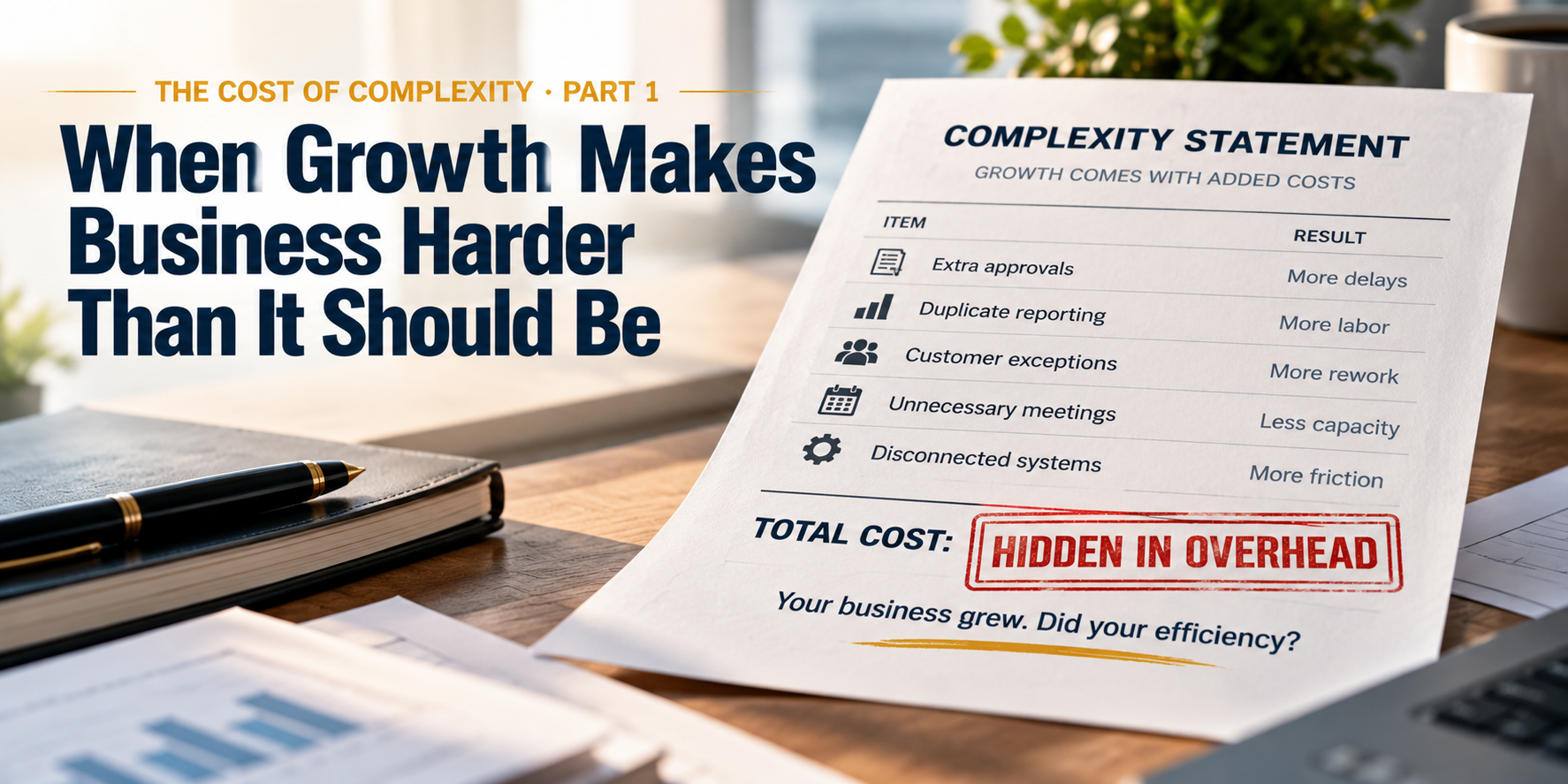
Complexity can show up as:
- Higher labor costs: More people and more time required to accomplish the same work.
- Slower decisions: Additional approvals and handoffs delay execution.
- More errors: Every transfer of information creates another opportunity for misunderstanding.
- Reduced accountability: When everyone participates, it can become unclear who actually owns the result.
- Lost opportunities: Employees spend time navigating internal processes instead of serving customers or improving the business.
The challenge is that these costs rarely appear on a financial statement under a line item called Complexity.
They're buried inside payroll, overhead, delays, rework, and missed opportunities.
More Revenue Doesn't Automatically Mean More Profit
Imagine two companies that each grow revenue by 20%.
One increases its operating capacity through clearer processes, stronger leadership, and better systems.
The other adds people, meetings, exceptions, and approval requirements to manage the additional work.
Both companies grew.
But their economics may look very different.
One has become more productive.
The other may have become more expensive.
Revenue growth can conceal declining operational efficiency.
That's why a growing company can feel increasingly busy without becoming proportionately more profitable.
Not All Complexity Is Bad
Some complexity is necessary.
A growing company may need stronger financial controls, more specialized roles, better compliance practices, or additional coordination.
Those additions can create real value.
The question isn't whether the business has become more complex.
It's whether the complexity is earning its keep.
Does the additional process reduce meaningful risk?
Does the new system improve performance?
Does the approval improve decision quality?
Does the meeting produce an outcome that couldn't be achieved more efficiently?
If the answer is no – or nobody knows the answer – the organization may be carrying costs that no longer create corresponding value.
Five Questions Worth Asking
You don't need an elaborate transformation program to begin identifying unnecessary complexity.
Start by asking your leadership team:
- What takes longer today than it did two years ago?
- Which decisions require more approvals than the risk justifies?
- Where are we doing the same work in multiple departments or systems?
- Which customer exceptions have quietly become permanent processes?
- What would we stop doing if we were designing this business from scratch today?
The answers may reveal something surprising.
Some of the biggest opportunities to improve performance aren't about adding resources.
They're about removing obstacles.
Final Thought
Growth should create new opportunities, greater capability, and stronger performance.
But when complexity accumulates faster than value, the organization can become larger without becoming better.
And the costs aren't always obvious.
They're hidden in the extra meeting.
The unnecessary approval.
The duplicate report.
The customer exception nobody revisited.
The process everyone follows because that's how we've always done it.
The question isn't simply how much your company has grown.
It's how much harder you've made it to operate along the way.
Coming Next
Part 2: The Approval Trap – When Controls Start Slowing the Business
We'll examine how well-intended approval requirements can multiply, delay decisions, and create costs that exceed the risks they were designed to manage.
📅 [Schedule a Strategy Alignment Session]
Let's determine whether your organization's growing complexity is creating meaningful value – or quietly consuming the capacity and profitability you've worked to build.

Chris Scherer
Chris is a transformation leader with over 25 years of experience driving significant value and mitigating risks across a broad range of industries and functions. With a track record of generating more than $450 million in savings, he has excelled in both challenging and thriving environments within small businesses, mid-market firms, and Fortune 500 companies. A dual-degree graduate of Thunderbird and ESADE, Chris started his career at Arthur Andersen and progressed through roles from Corporate Audit to Global Human Resources at various Fortune 500 firms. He played a pivotal role in growing AArete, a global management consultancy, where he led initiatives that significantly reduced non-labor costs and improved compliance processes. An advocate for sustainable community initiatives, Chris was a founding member of a nonprofit focused on creating bicycle-friendly communities in New Jersey.