Why More Systems Don't Always Mean Better Information
The Cost of Complexity – Part 4
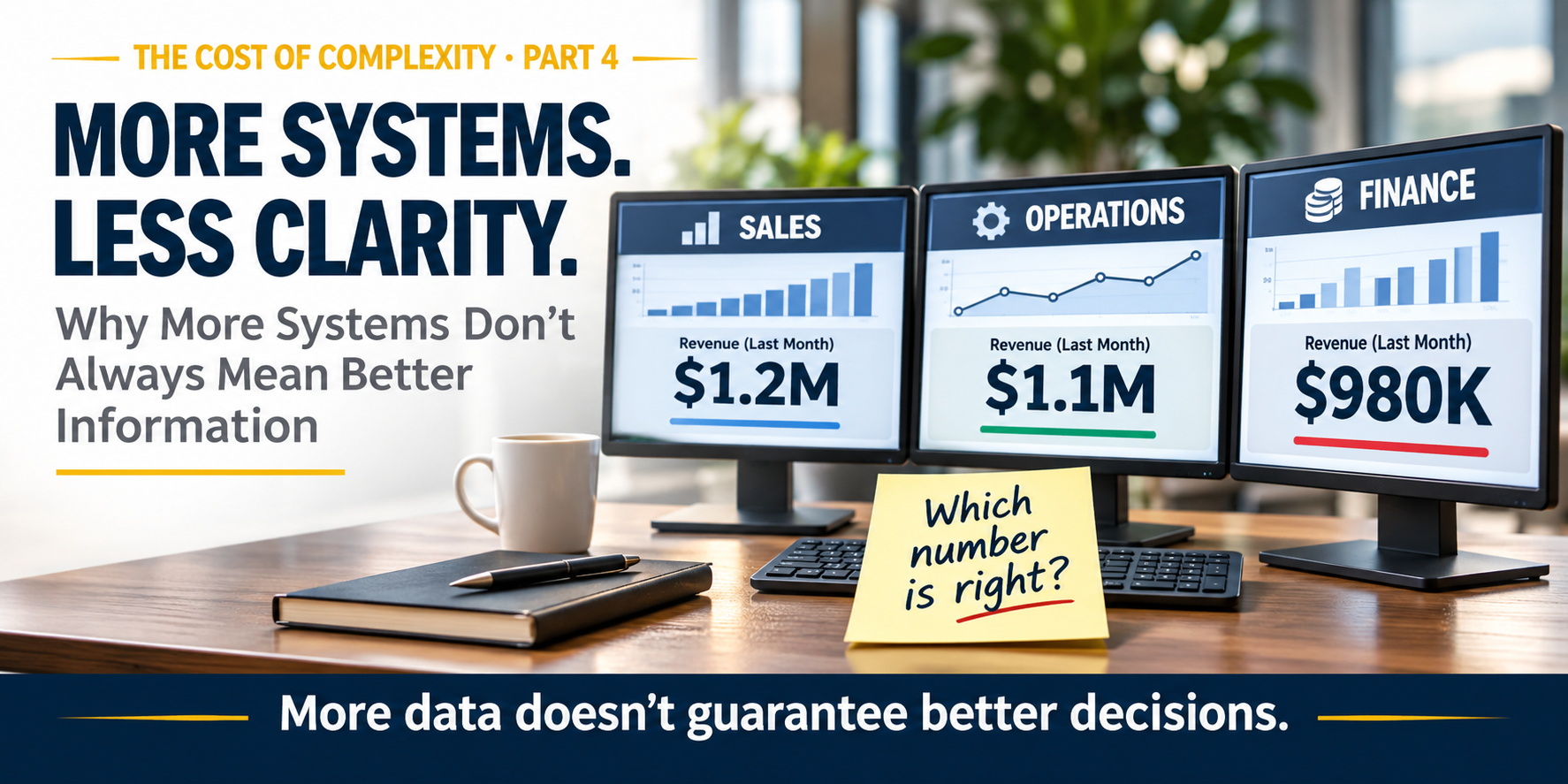
The CEO asked a simple question: "What was our profit last month?"
Finance had one number.
Operations had another.
Sales had a dashboard showing something different.
And the management team spent the next 45 minutes trying to determine which report was correct.
The company had invested in better technology, more reporting, and additional dashboards.
Yet answering a basic business question had become more difficult.
The problem wasn't a lack of information. It was a lack of agreement about what the information meant.
When Technology Creates More Work
Most organizations don't set out to build complicated systems.
They add technology to solve legitimate problems.
Sales needs a CRM.
Finance needs accounting software.
Operations needs scheduling or project management tools.
Human Resources needs systems to manage employees, hiring, and performance.
Each investment makes sense individually.
As we explored in Part 1, complexity accumulates through individually reasonable decisions that eventually create problems nobody intended.
But as the business grows, these systems often develop independently.
Different departments maintain different records, use different definitions, and create their own reports.
Eventually, leadership discovers that the organization has plenty of data – but no consistent view of performance.
More technology has produced more information without necessarily producing more clarity.
The Spreadsheet Between the Systems
One of the clearest warning signs is the spreadsheet someone must maintain to make the other systems agree.
Consider a growing service company.
Sales tracks customer commitments in its CRM.
Operations manages delivery schedules in a separate platform.
Finance records revenue and costs in its accounting system.
Every month, someone exports information from all three systems, combines it in Excel, corrects inconsistencies, and prepares a management report.
The process works – until someone is unavailable, a formula breaks, or the underlying data changes.
Now the business depends on an informal reporting process that may not be documented, automated, or independently verified.
And what should have been a routine management report becomes a recurring reconciliation exercise.
The spreadsheet isn't necessarily the problem.
The problem is that the business needs a workaround to understand its own performance.
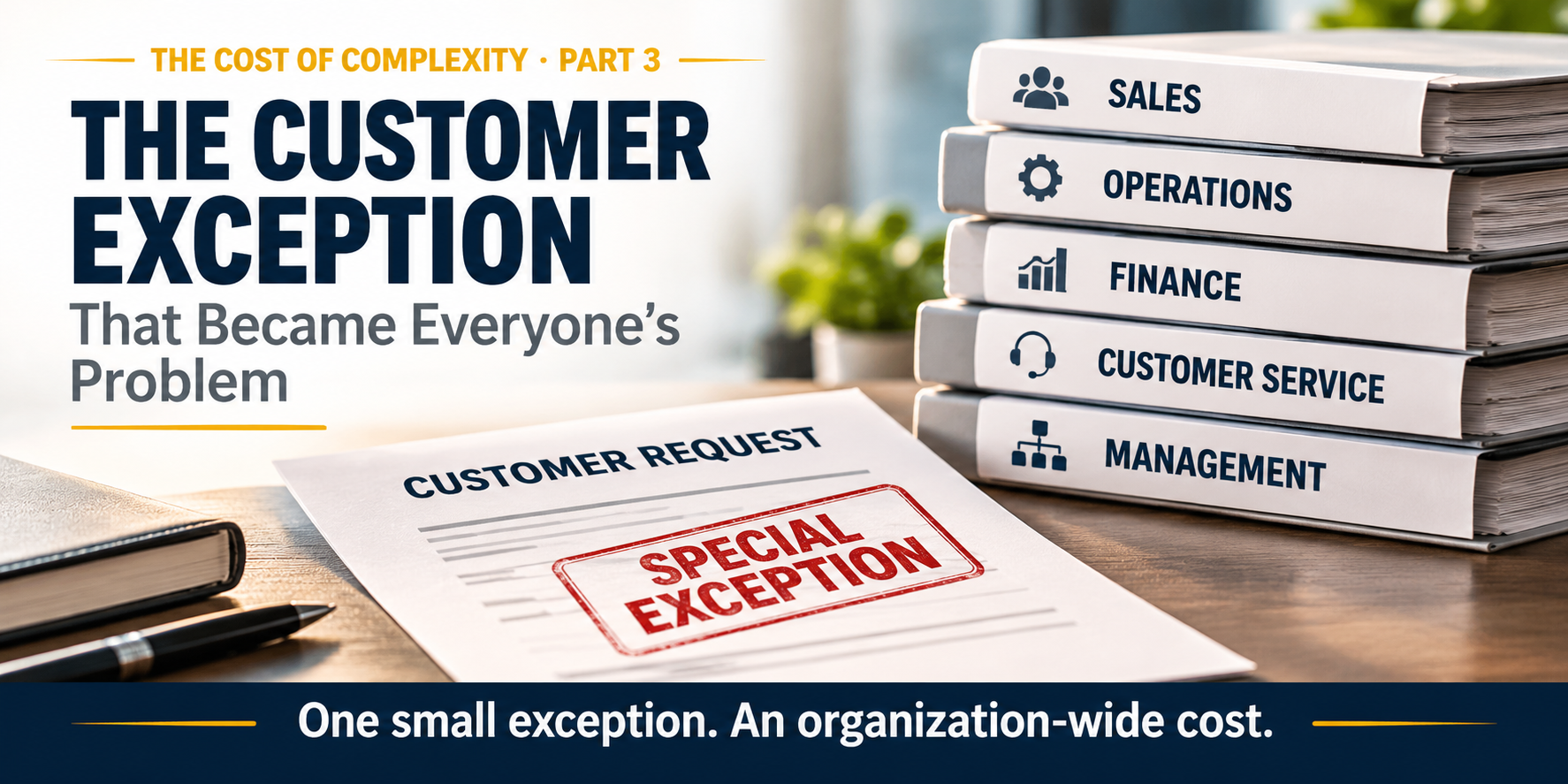
The same pattern appears when one customer exception can create work across multiple departments, as we examined in Part 3.
When Every Department Has Its Own Truth
Disconnected systems create more than administrative inefficiency.
They can undermine leadership alignment.
Sales reports that revenue is increasing.
Operations reports that capacity is stretched.
Finance reports that margins are declining.
Each department may be accurately describing what its own system measures.
But those measures may not be connected in a way that explains what's happening across the business.
For example, a growing sales pipeline may look encouraging until leadership recognizes that the new business requires unusually high delivery costs.
Or operations may appear to be meeting its productivity targets while customer service absorbs the cost of recurring problems.
Without a shared understanding of performance, supported by consistent definitions and connected reporting, executives can spend more time debating the numbers than addressing the underlying issues.
When leaders don't share the same understanding of performance, they struggle to make aligned decisions.
The Hidden Cost of Another Dashboard
Dashboards can be valuable.
They can also create the illusion of control.
A new dashboard may provide additional charts, metrics, and visualizations without answering the questions leadership actually needs to resolve.
What decisions should this information support?
Who owns the accuracy of the underlying data?
How frequently does it need to be updated?
What action should follow when a metric moves outside expectations?
If those questions remain unanswered, another dashboard may simply become another reporting obligation.
And every additional report requires time to create, validate, review, and explain.
The cost isn't limited to software subscriptions.
It includes the management attention consumed by information that doesn't lead to better decisions.
Five Questions Before Adding Another System
Before investing in another platform, dashboard, or reporting tool, leadership should ask:
- What decision are we trying to improve? Start with the business question, not the technology.
- Do we already have the information somewhere? Determine whether the problem is missing data or difficulty accessing and interpreting existing data.
- Who owns the information? Establish responsibility for accuracy, definitions, and timely updates.
- How will the new system connect to existing processes? Understand the impact on workflows, handoffs, reporting, and accountability.
- What can we eliminate? Every new system should create an opportunity to retire redundant reports, manual processes, or unnecessary tools.
These questions don't argue against technology.
They help ensure technology solves the right problem.
Better Information Begins With Better Alignment
Technology can accelerate a well-designed process.
It can also accelerate confusion.
If departments disagree about what success means, which metrics matter, or who is responsible for acting on information, software alone won't resolve those differences.
Leadership must first establish a common understanding of objectives, performance measures, decision rights, and accountability.
That includes delegating decisions rather than simply assigning tasks, so the people closest to the information can act within clearly defined boundaries.
Then technology can support those agreements.
This changes the conversation from:
What software should we buy?
To:
What do we need to know, who needs to know it, and what decisions should follow?
That's a much more useful starting point.
Final Thought
The goal isn't to have fewer systems simply for the sake of simplicity.
It's to have the right systems working together to support better decisions.
A business doesn't become more sophisticated because it has more dashboards.
It becomes more effective when leaders can trust the information, understand what it means, and act on it.
More data isn't the same as better information. And better information isn't valuable until it leads to better decisions.
Coming Next
Part 5: The Hidden Cost of One More Meeting
We'll examine how organizations add meetings to improve coordination – only to discover that those meetings consume leadership capacity, slow execution, and sometimes replace the accountability they were supposed to create.
Schedule a Strategy Alignment Session
Are your leaders spending more time reconciling reports than making decisions?
CXO Accelerator helps leadership teams align business objectives, performance measures, accountability, and execution so the organization can make better decisions with greater confidence.
Let's identify where disconnected information and organizational complexity are slowing your business.

Chris Scherer
Chris is a transformation leader with over 25 years of experience driving significant value and mitigating risks across a broad range of industries and functions. With a track record of generating more than $450 million in savings, he has excelled in both challenging and thriving environments within small businesses, mid-market firms, and Fortune 500 companies. A dual-degree graduate of Thunderbird and ESADE, Chris started his career at Arthur Andersen and progressed through roles from Corporate Audit to Global Human Resources at various Fortune 500 firms. He played a pivotal role in growing AArete, a global management consultancy, where he led initiatives that significantly reduced non-labor costs and improved compliance processes. An advocate for sustainable community initiatives, Chris was a founding member of a nonprofit focused on creating bicycle-friendly communities in New Jersey.