"I already delegate."
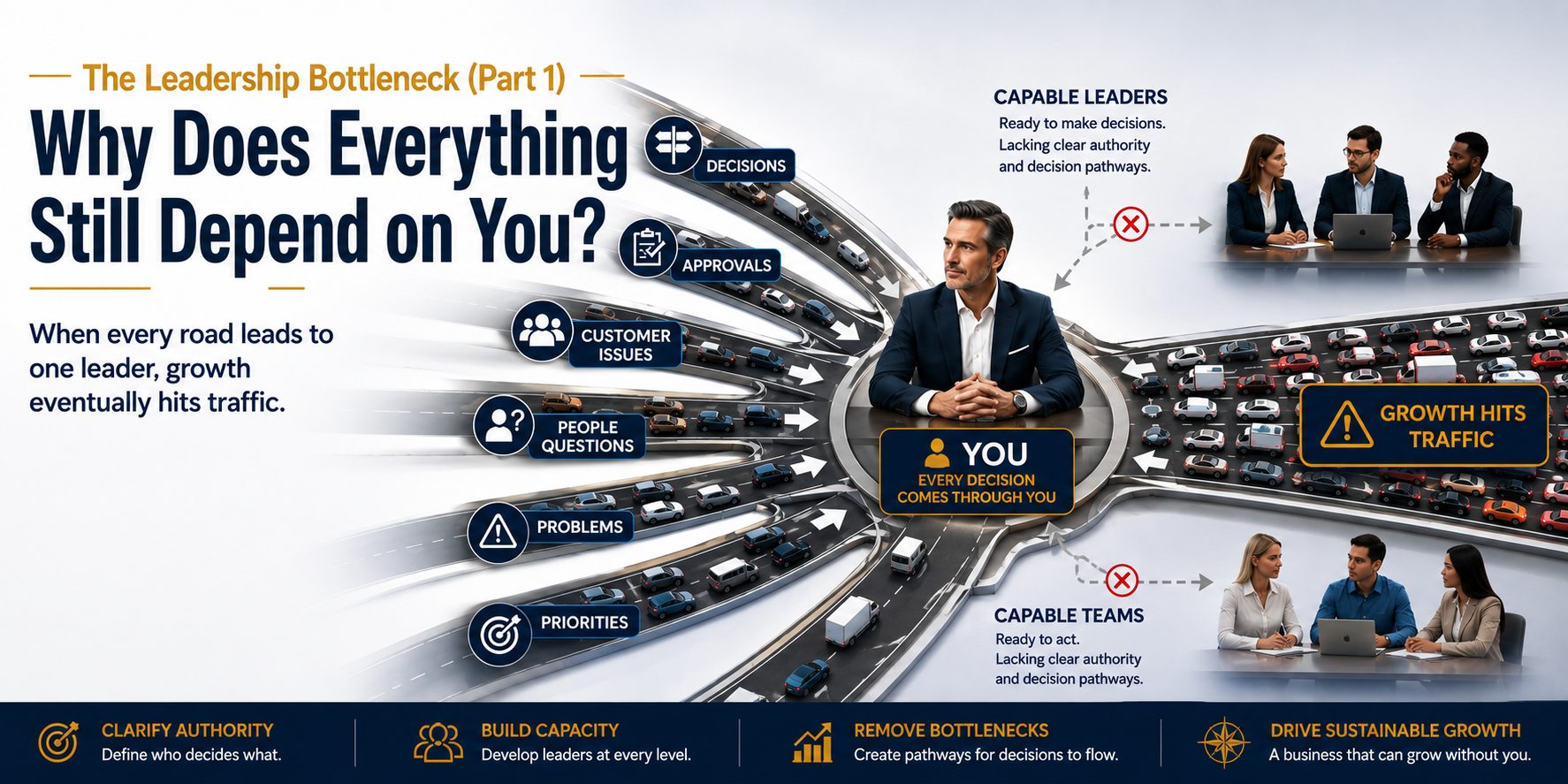
Most leaders experiencing a bottleneck probably do.
They've hired managers.
Assigned responsibilities.
Handed off projects.
Built departments.
Yet decisions still keep coming back.
Why?
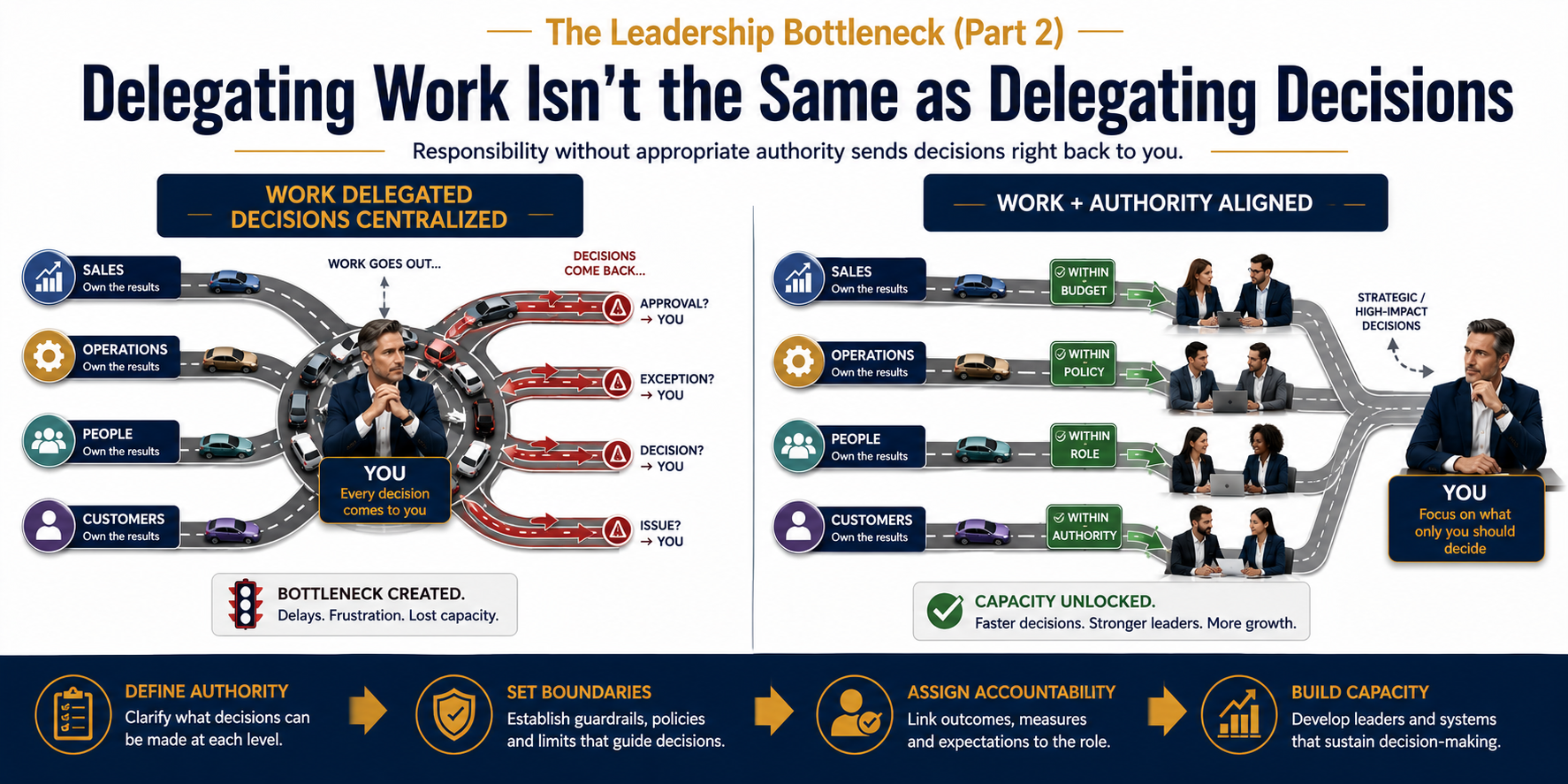
Because delegating work isn't the same as delegating the authority to make decisions about that work.
Responsibility Without Authority
Imagine telling a sales leader:
"You're responsible for growing this account."
But then requiring approval to:
- Adjust pricing.
- Resolve a customer complaint.
- Change contract terms.
- Allocate additional resources.
- Make an exception.
Technically, you've delegated responsibility.
Operationally, you've kept control.
So every time something falls outside the normal path, the decision travels right back up the organization.
That's how leaders remain bottlenecks even after they've delegated much of the work.
Why Leaders Hold On
Usually, there's a reason.
The leader may have:
- More experience.
- Better context.
- Stronger customer relationships.
- Greater financial visibility.
- Institutional knowledge others don't yet have.
And frequently, making the decision yourself really is faster.
Today.
That's the trap.
Solving the problem yourself may save ten minutes today while ensuring you'll be asked to solve the same kind of problem again tomorrow.
Efficiency in the moment can create dependency over time.
The Other Side of Delegation
Simply telling people:
"You don't need to ask me anymore."
isn't the answer either.
Delegating decision authority without appropriate boundaries can create a different set of problems.
People need to understand:
- What they can decide.
- How much authority they have.
- Which principles should guide the decision.
- What outcomes they're accountable for.
- When an issue should be escalated.
That's not abdication.
That's designing decision authority.
Move the Decision Closer to the Work
In many organizations, the best information about a decision exists closer to the customer, process, employee, or problem.
Yet the authority to act may sit several levels above it.
That creates delay.
Information travels upward.
A decision travels downward.
Questions travel back upward.
Meanwhile, the customer, employee, or project waits.
When appropriate decisions can be made closer to the work, the organization becomes faster – and senior leaders regain capacity for decisions that actually require their perspective.
The Leader Still Has a Role
The goal isn't to decentralize every decision.
Some decisions should remain at the top.
Strategy.
Major capital allocation.
Enterprise risk.
Senior leadership.
Decisions with significant or irreversible consequences.
The challenge is distinguishing those decisions from the hundreds of smaller ones that accumulate simply because "we've always asked the boss."
A useful question is:
What's the lowest appropriate level at which this decision can be made well?
Not the lowest possible level.
The lowest appropriate level.
Accountability Has to Travel With Authority
There's an important second half to this.
Authority without accountability isn't empowerment.
It's ambiguity.
If a leader owns an outcome, that person should understand the measures, boundaries, and expectations associated with it.
Then the conversation changes from:
"Can I do this?"
to:
"Here's what I decided, why I decided it, and what happened."
That's a very different organization.
Start With the Decisions That Keep Finding You
If you're wondering where to begin, don't redesign the entire organization.
For a week, notice every decision that comes to you.
Then ask:
- Did this actually require me?
- Who had the information needed to make it?
- Why didn't that person feel authorized to decide?
- What boundary or expectation would allow them to decide next time?
Patterns will appear quickly.
And some of those patterns may explain why you're still so busy despite having a capable team.
Final Thought
Delegation isn't measured by how much work leaves your desk.
It's measured, in part, by how much appropriate decision-making capacity exists throughout the organization.
The goal isn't to make fewer decisions simply because you're tired of making them.
It's to make sure decisions are made by the right people, at the right level, with the right information and accountability.
That's how delegation stops being task management...
and starts building organizational capacity.
Coming Next
Part 3: Why Adding People Doesn't Always Add Capacity
📅 [Schedule a Strategy Alignment Session]
Let's determine whether your leaders truly own their outcomes – or still need your permission to produce them.