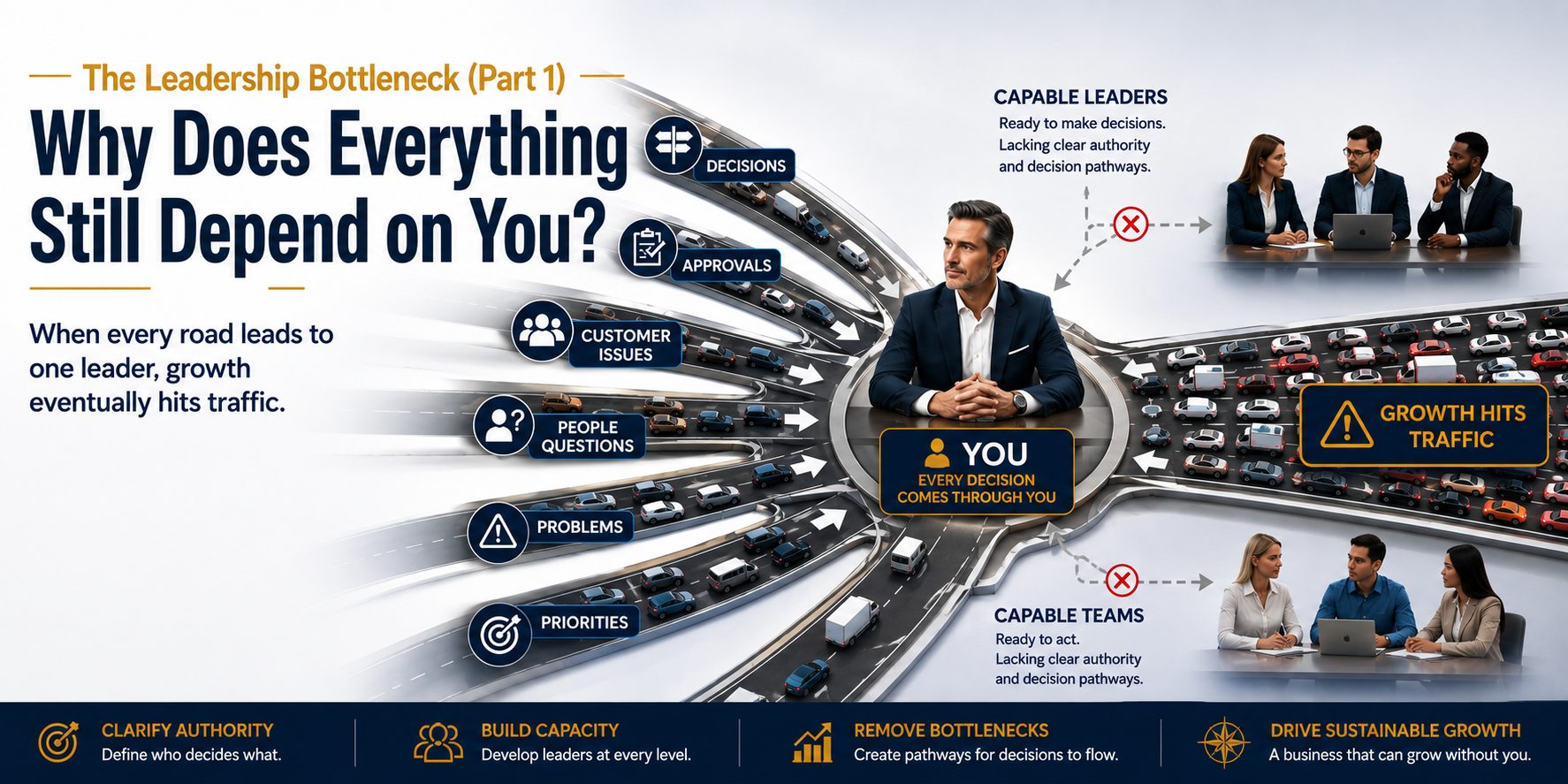
You built a team so everything wouldn't depend on you.
So why does everything still depend on you?
A customer problem gets escalated.
A manager needs approval.
Someone has a question about pricing.
A project stalls until you weigh in.
An employee issue lands on your desk.
And before long, you're back in the middle of a business you hired capable people to help run.
This isn't necessarily a people problem.
And it isn't always a delegation problem.
Sometimes, the business has simply grown faster than its leadership model.
Growth Changes the Leader's Job
Early in a company's life, having everything run through one or two leaders can work remarkably well.
Decisions are fast.
Communication is direct.
The owner knows the customers, employees, numbers, and operations.
Being deeply involved is often an advantage.
Then the business grows.
More customers.
More employees.
More managers.
More locations, products, services, systems, or complexity.
But there's a problem:
The way decisions get made doesn't always grow with it.
The organization gets bigger.
The leader's capacity doesn't.
The Symptoms Are Easy to Recognize
A leadership bottleneck rarely appears on an organizational chart.
It looks more like this:
- Decisions wait for one person.
- Managers routinely escalate issues upward.
- Employees seek approval when they could make the decision themselves.
- Meetings exist primarily to keep the leader informed.
- Projects slow when the leader is unavailable.
- Senior leaders remain involved in surprisingly small decisions.
And perhaps the most telling symptom:
The organization can move only as fast as a few key people can think, decide, approve, and respond.
But Why Does Everything Keep Coming Back?
It's tempting to conclude:
"My people need to take more ownership."
Sometimes they do.
But consider another possibility.
Have we clearly defined:
- Which decisions they own?
- Where their authority begins and ends?
- What outcomes they're accountable for?
- When they should escalate something?
- What "good judgment" looks like in their role?
If those things aren't clear, coming back to the leader is often the safest and most rational choice.
The organization may be producing exactly the behavior its leadership system encourages.
Delegating Tasks Isn't Enough
This is where many growing organizations get stuck.
They delegate work without delegating enough authority.
A manager may be responsible for delivering the result but still need approval for the decisions required to produce it.
That's responsibility without control.
And it sends work right back up the organization.
The leader becomes the traffic intersection through which everything must pass.
The Question Changes
At some point, the leadership question has to evolve from:
"How can I get more done?"
to:
"How can the organization get more done without requiring me to be involved in everything?"
That's a fundamentally different challenge.
It means building leadership capacity around you rather than simply increasing your own capacity.
A Simple Test
Imagine disappearing from the business for two weeks.
Not answering email.
Not taking calls.
Not approving decisions from your phone.
What would happen?
Would your leaders know what they could decide?
Would priorities remain clear?
Would customer problems get resolved?
Would important work continue moving?
Or would decisions begin stacking up?
That answer tells you something important about the organization you've built.
Final Thought
Being indispensable can feel like evidence of leadership success.
As the organization grows, it can become evidence of organizational dependency.
The goal isn't to make the leader less important.
It's to make the leader important for different things – direction, priorities, major decisions, developing leaders, allocating resources, and preparing the organization for what comes next.
Because eventually, sustainable growth requires the business to develop something the leader can never personally create more of:
capacity beyond themselves.
Coming Next
Part 2: Delegating Work Isn't the Same as Delegating Decisions
📅 [Schedule a Strategy Alignment Session]
Let's determine whether your growth is constrained by market opportunity – or by how decisions, authority, and accountability flow through your organization.