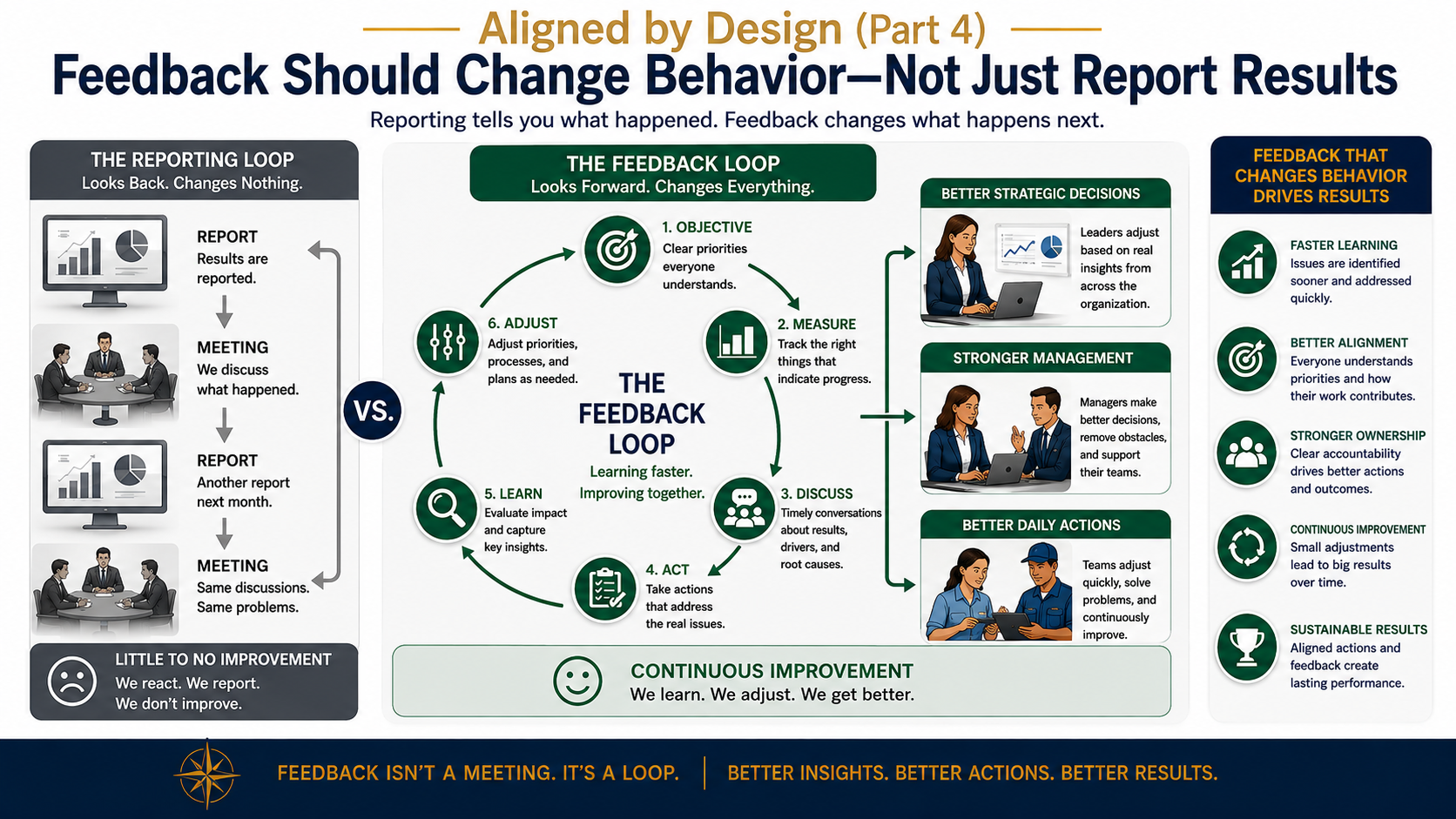
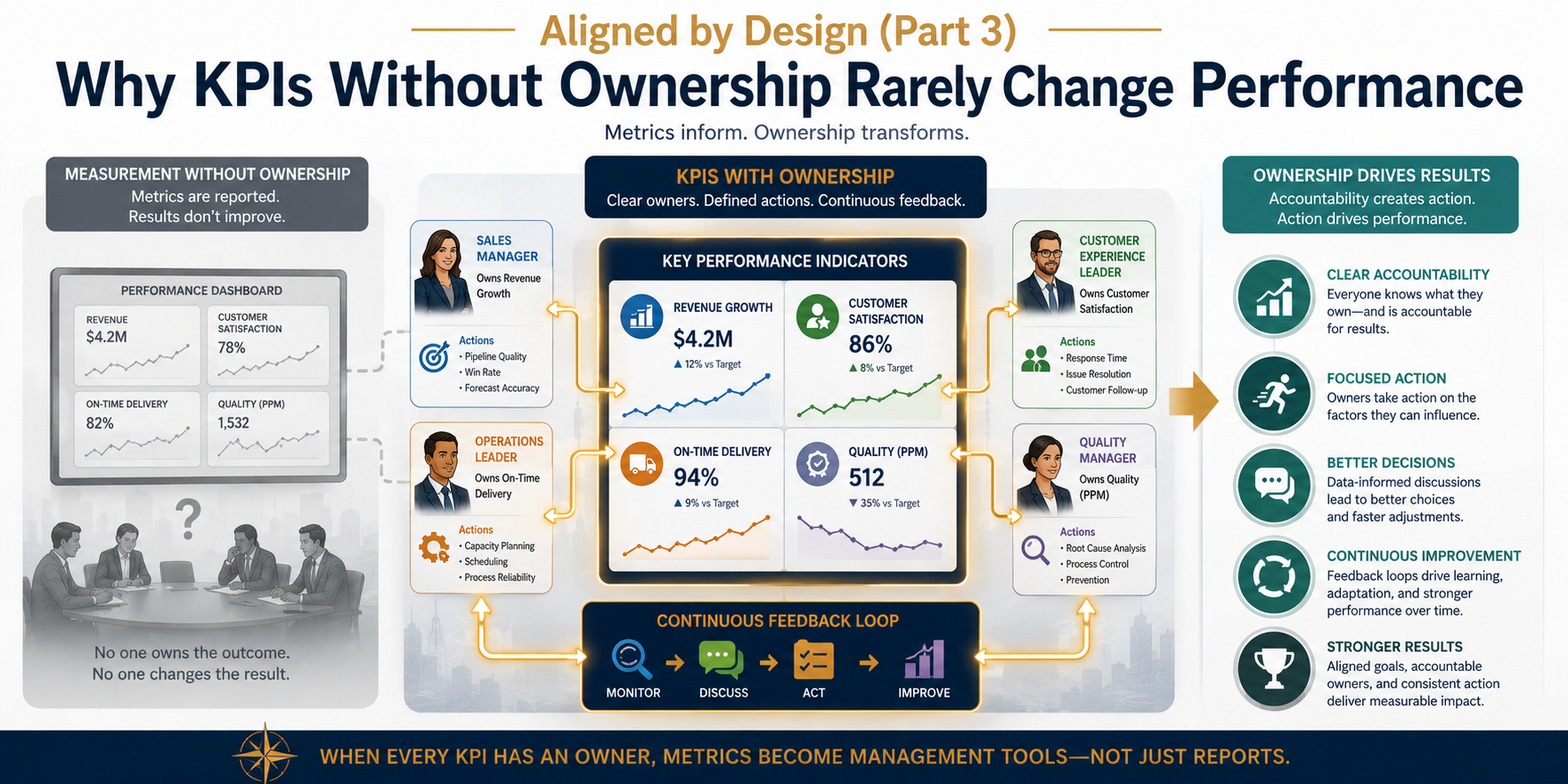
Most organizations provide plenty of feedback.
Dashboards report results.
Managers review performance.
Leadership teams discuss KPIs.
Employees receive updates.
But here's the question that matters:
What changes because of it?
If the answer is "not much," the organization doesn't have a feedback loop.
It has a reporting loop.
Reporting Looks Back. Feedback Moves Forward.
A KPI tells you what happened.
Revenue missed target.
A project ran late.
Customer satisfaction declined.
Quality improved.
Useful information – but only if someone uses it to decide what happens next.
Effective feedback connects:
Result → Discussion → Action → Measurement → Adjustment
Without that loop, organizations can spend months discussing the same problems.
Feedback Needs to Reach the People Doing the Work
This is where alignment matters.
Executives shouldn't be the only people who understand whether the strategy is working.
Managers and employees need to know:
- What result they're trying to influence.
- What activities affect that result.
- Whether those activities are working.
- What they should do differently.
Consider an objective to improve customer retention.
Leadership may track retention monthly.
But the people influencing that number every day may need much more immediate feedback around response times, unresolved issues, service quality, follow-up, or other activities they can actually control.
The closer feedback gets to the work, the more useful it becomes.
Good Feedback Isn't About Blame
Accountability sometimes gets confused with finding out who caused a problem.
That's not the goal.
Good feedback asks:
What are the results telling us – and what should we change?
Maybe the process is broken.
Maybe expectations aren't clear.
Maybe someone needs additional skills or resources.
Maybe priorities are competing.
Or maybe the original objective itself needs to change.
Feedback helps leaders discover those things before a small problem becomes a large one.
Create a Shorter Learning Loop
Imagine two organizations.
One discovers a performance problem during a quarterly review.
The other sees an early indicator this week, discusses it with the people involved, makes an adjustment, and measures the result next week.
Which one learns faster?
That's the real power of feedback.
It's not simply evaluating performance.
It's shortening the distance between a result and a better decision.
Every Level Needs the Loop
In an aligned organization:
- Leaders receive feedback on strategic objectives.
- Managers receive feedback on team performance.
- Employees receive feedback on the activities they influence.
- Information travels back upward when assumptions or conditions change.
Feedback doesn't just flow down the organization.
It moves both directions.
That's how strategy stays connected to reality.
Final Thought
Measurement tells you where you are.
Feedback helps you decide what to do next.
And when objectives, ownership, measures, action, and feedback are connected, something important happens:
The organization learns.
That's when continuous improvement stops being an initiative and becomes part of how the business operates.
Coming Next
Part 5: Meetings Don't Create Alignment – Operating Rhythms Do
📅 [Schedule a Strategy Alignment Session]
Let's determine whether your organization is simply reviewing results – or using feedback to continuously improve them.