Most organizations measure plenty of things.
Revenue.
Margins.
Customer satisfaction.
On-time delivery.
Employee turnover.
Dashboards are full of numbers.
Yet many leadership teams still ask:
"Why aren't the results improving?"
The answer usually isn't that you're measuring the wrong things.
It's that no one truly owns them.
A KPI Isn't an Outcome
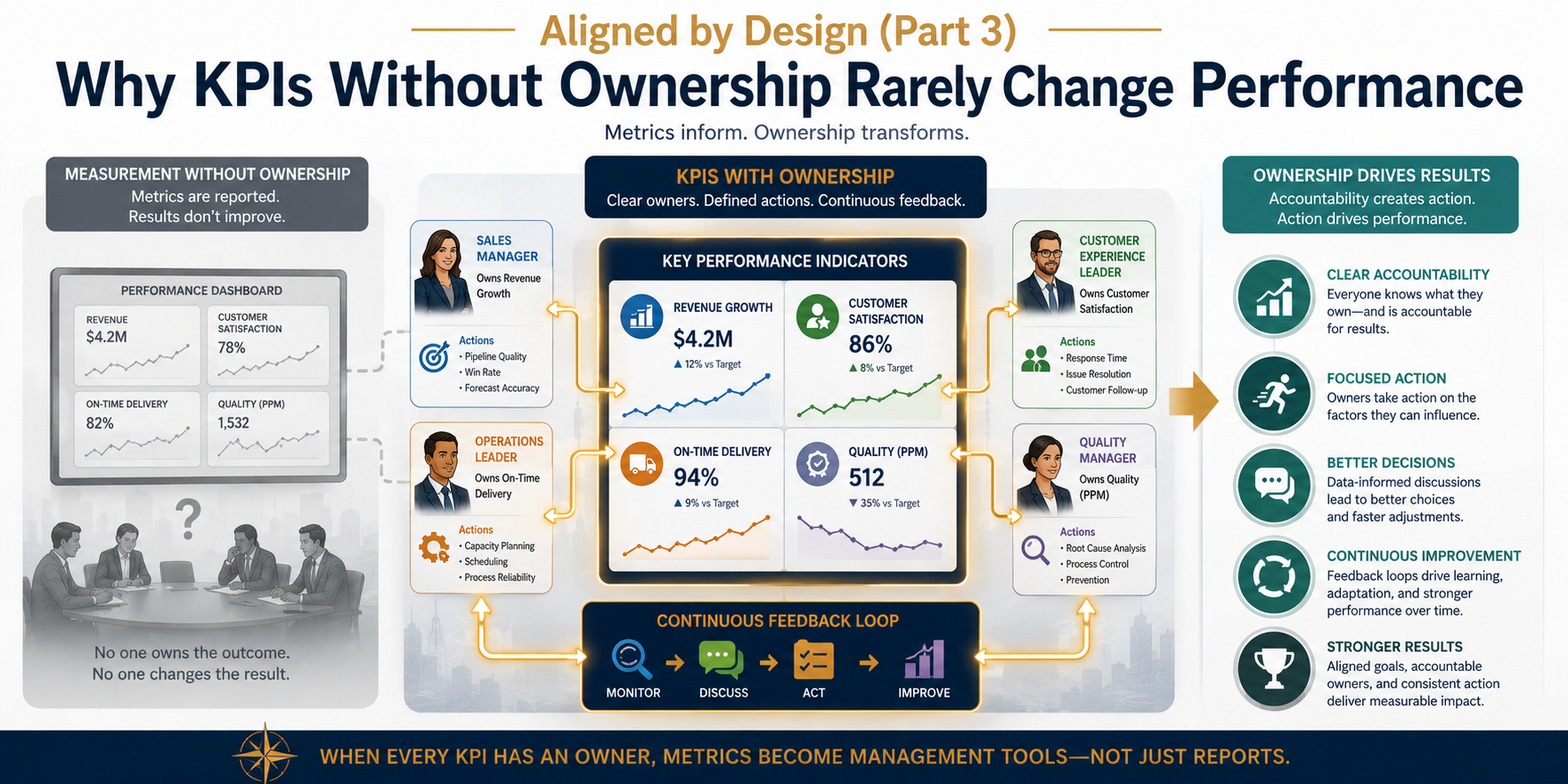
A Key Performance Indicator is exactly that – an indicator.
It tells you what's happening.
It doesn't tell you:
- Who is responsible.
- What actions should change.
- When intervention is needed.
- How success will be achieved.
Without ownership, a KPI becomes something people review – not something they improve.
The Difference Between Reporting and Managing
Many organizations hold monthly meetings to review performance.
The conversation often sounds like this:
"Sales are down."
"Customer response times increased."
"Quality slipped this month."
The data is accurate.
But the next question is often missing:
Who owns improving this?
Without a clear owner, metrics become observations instead of commitments.
Ownership Creates Alignment
Strong organizations don't stop at assigning metrics.
They assign responsibility.
Every meaningful measure should answer four questions:
- Who owns this result?
- What actions influence it?
- How often is it reviewed?
- What happens if it moves in the wrong direction?
When those answers are clear, KPIs become management tools – not historical reports.
Feedback Drives Improvement
Ownership isn't about blame.
It's about creating a learning system.
When someone owns a measure, they can:
- Identify trends early.
- Adjust priorities.
- Remove obstacles.
- Improve processes.
- Learn from results.
That's how continuous improvement happens.
From Measurement to Performance
Metrics don't improve organizations.
People do.
The purpose of a KPI isn't to fill a dashboard.
It's to create clarity, accountability, and better decisions.
When every important measure has a clear owner, aligned actions, and regular feedback, performance becomes far more predictable.
Final Thought
Organizations rarely improve because they measure more.
They improve because people understand:
- what they're responsible for,
- how success is measured,
- and what actions produce better outcomes.
Measurement informs.
Ownership transforms.
Coming Next
Part 4: Why Feedback Should Change Behavior – Not Just Report Results
📅 [Schedule a Strategy Alignment Session]
Let's determine whether your KPIs are simply measuring performance – or helping people improve it.