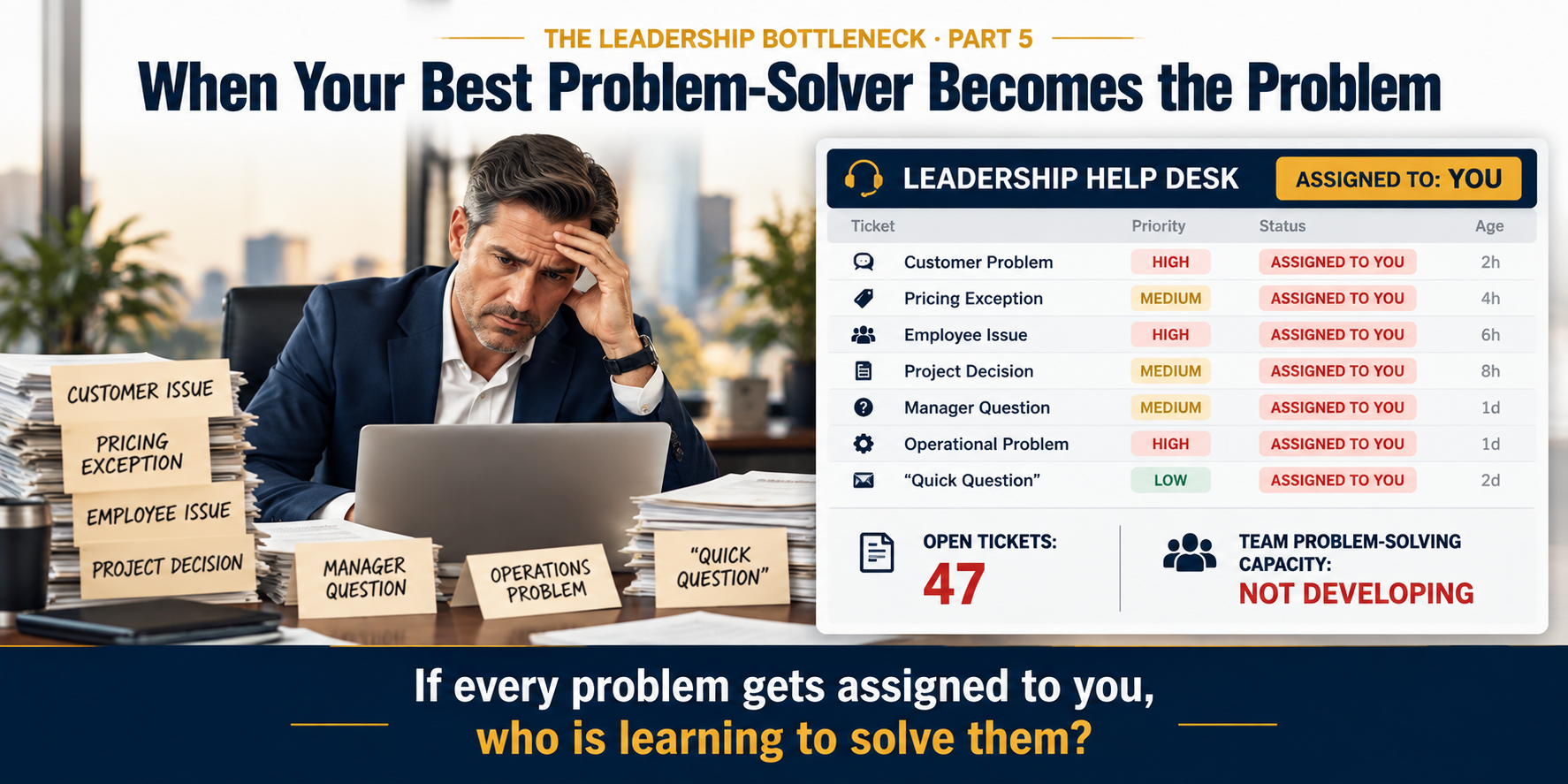
The Leadership Bottleneck (Part 6): What Should Only You Be Doing?
There's always more work.
More emails.
More meetings.
More problems.
More decisions.
More people who need something.
So perhaps the most important question for a growing leader isn't:
“What should I do next?”
It's:
“What should only I be doing?”
Because those are two very different questions.
Being Busy Isn't the Same as Leading
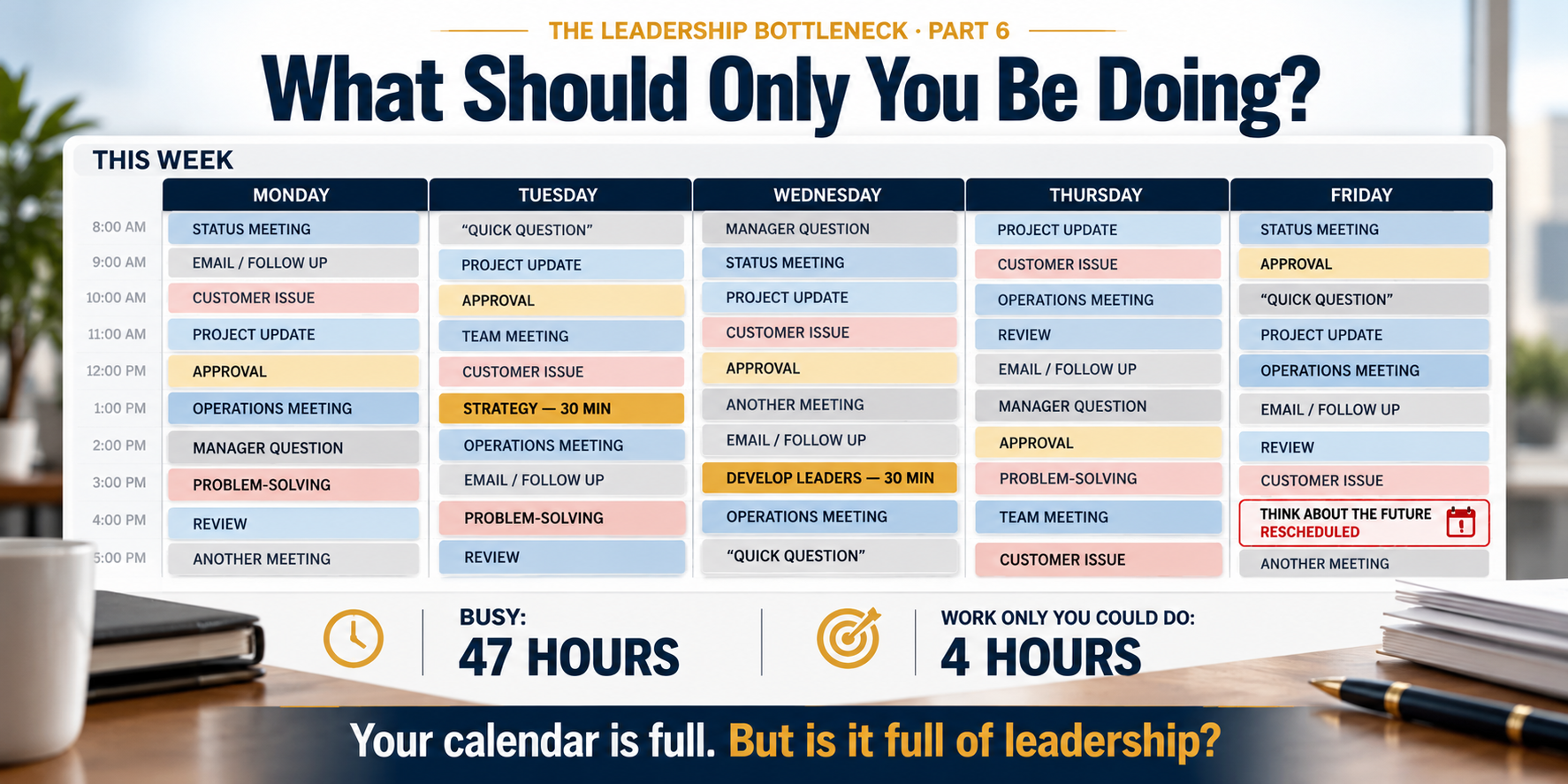
Look at an executive's calendar and you'll often find an impressive amount of activity.
Customer meetings.
Internal meetings.
Project reviews.
Approvals.
Problem-solving.
Email.
Employee issues.
Operational discussions.
Most of it is legitimate work.
Some of it may even be important.
But here's the problem:
Every hour spent doing something someone else could appropriately do is an hour unavailable for something only the leader can do.
That's where a leadership bottleneck becomes especially expensive.
The Work Only You Can Do
The answer varies by organization and leadership role.
But for an owner, CEO, or senior executive, it often includes things like:
- Setting direction.
- Establishing priorities.
- Making high-consequence decisions.
- Allocating major resources.
- Developing key leaders.
- Protecting critical relationships.
- Identifying emerging risks.
- Evaluating major opportunities.
- Shaping culture.
- Preparing the organization for what comes next.
These responsibilities share something important.
They're difficult to delegate because they derive much of their value from the position, perspective, judgment, or accountability of the leader.
Compare those with:
- Routine approvals.
- Status updates.
- Scheduling issues.
- Operational troubleshooting.
- Decisions someone else already has enough information to make.
- Meetings the leader attends “just in case.”
Those activities may still matter.
They just may not require you.
Your Calendar Reveals the Real Strategy
Ask an executive about their priorities and you might hear:
Growth.
Developing the leadership team.
Key customers.
Strategy.
Building the organization for the future.
Now look at the calendar.
Where is that work?
If developing leaders is a priority but receives 30 minutes a month, while operational meetings consume 15 hours a week, the calendar is telling a different story.
If strategy matters but gets whatever time remains after everything urgent is finished, strategy isn't really being prioritized.
Your calendar is where stated priorities collide with actual behavior.
Urgent Work Has an Unfair Advantage
Operational work is difficult to resist because it announces itself.
The customer calls.
The email arrives.
The manager walks in.
The problem needs an answer.
Strategic leadership work often behaves differently.
Nobody sends an urgent email saying:
“Please spend two uninterrupted hours thinking about where this company needs to be three years from now.”
Developing a future leader rarely feels as urgent as solving today's customer problem.
Thinking about organizational capability rarely feels as immediate as approving today's expenditure.
But urgency and value aren't the same thing.
And unless leaders deliberately protect capacity for high-value work, the immediate tends to consume the important.
Try a Different Calendar Audit
Don't simply look for wasted time.
Instead, review the last two weeks and place each significant activity into one of three categories:
ONLY ME
This genuinely required my role, authority, relationships, judgment, or accountability.
DEVELOP SOMEONE
Someone else could eventually own this, but they need coaching, context, authority, or experience first.
SHOULDN'T BE ME
Someone else could appropriately own this now.
That middle category matters.
Not everything can be delegated tomorrow.
But identifying what could eventually move turns delegation into a leadership-development plan rather than a dumping exercise.
Reclaiming Time Isn't the Goal
There's another trap here.
Suppose a leader successfully removes five hours of low-value activity from the week.
Great.
Then what?
If those five hours immediately get filled with more email, more meetings, and more operational work, nothing really changed.
The objective isn't simply to create an emptier calendar.
It's to deliberately reinvest leadership capacity.
Perhaps those five hours become:
Two hours developing leaders.
One hour with a strategic customer.
One hour examining future opportunities.
One uninterrupted hour thinking.
Now the organization is receiving something different from its leader.
The Role Has to Evolve With the Business
The work that made a leader valuable at $2 million in revenue may not be the work that makes that same leader valuable at $20 million.
Growth changes what the organization needs.
At one stage, the owner may personally sell, solve customer problems, hire employees, approve expenses, and oversee operations.
Eventually, continuing to do all of those things can prevent the organization from developing the people and systems required for the next stage.
That's one of the hardest transitions in leadership:
Success requires giving up work you're very good at so you can spend more time doing work the organization now needs more.
One Question for Friday Afternoon
At the end of this week, look back at where your time went.
Then ask:
“What did I do this week that only I could have done?”
If the list is short, don't immediately blame your calendar.
Look at the organization around it.
What decisions still depend on you?
What problems still escalate to you?
What responsibilities haven't truly transferred?
Which leaders need development?
Which roles lack authority?
Your calendar may simply be showing you where the leadership bottleneck still exists.
Final Thought
The objective of leadership isn't to become uninvolved.
It's to become involved where your involvement creates the most value.
As the organization grows, that requires continually asking:
What should I keep?
What should I develop someone else to own?
What should already be happening without me?
Because eventually, the question isn't whether you can do the work.
You probably can.
The question is whether you are still the right person to be doing it.
Coming Next
Part 7: Build a Business That Doesn't Need You in Every Decision
📅 [Schedule a Strategy Alignment Session]
Let's determine whether your leadership time is focused on the work only you should be doing—or consumed by work the organization should be capable of owning without you.

Chris Scherer
Chris is a transformation leader with over 25 years of experience driving significant value and mitigating risks across a broad range of industries and functions. With a track record of generating more than $450 million in savings, he has excelled in both challenging and thriving environments within small businesses, mid-market firms, and Fortune 500 companies. A dual-degree graduate of Thunderbird and ESADE, Chris started his career at Arthur Andersen and progressed through roles from Corporate Audit to Global Human Resources at various Fortune 500 firms. He played a pivotal role in growing AArete, a global management consultancy, where he led initiatives that significantly reduced non-labor costs and improved compliance processes. An advocate for sustainable community initiatives, Chris was a founding member of a nonprofit focused on creating bicycle-friendly communities in New Jersey.