The Customer Exception That Became Everyone's Problem
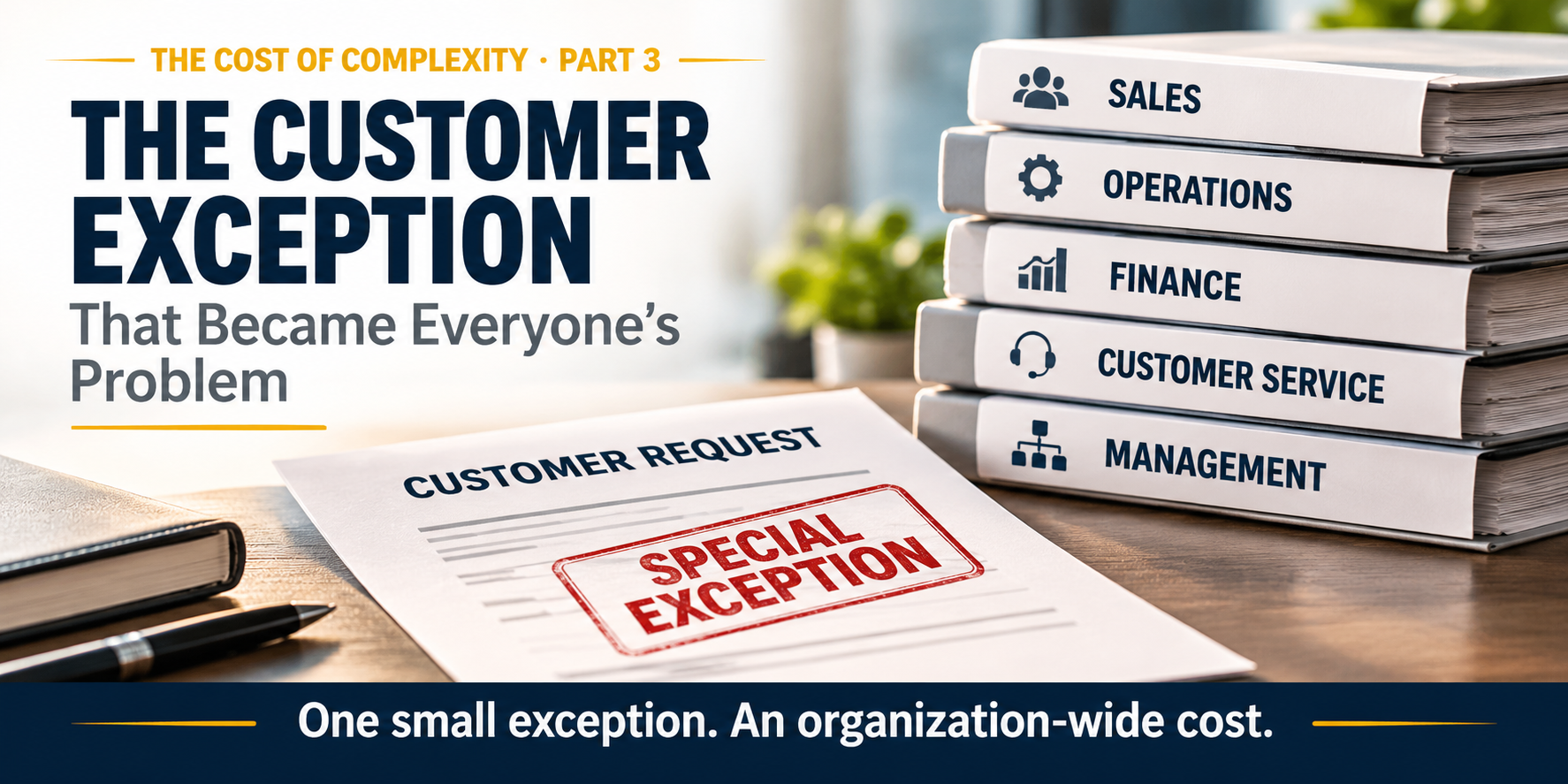
The Customer Exception That Became Everyone's Problem
The Cost of Complexity – Part 3
It started with one customer asking for a small favor.
A different delivery schedule.
A customized invoice.
A special discount.
An exception to the standard process.
The salesperson agreed. After all, it was an important customer, and the request seemed reasonable.
But fulfilling that promise required operations to adjust its schedule, finance to change its billing process, and customer service to remember an arrangement that wasn't documented anywhere.
What looked like a small accommodation became a recurring operational obligation.
And nobody calculated what it actually cost.
The customer received special treatment. The business inherited permanent complexity.
As we explored in Part 1, complexity accumulates through decisions that seem reasonable individually but become costly when repeated across the organization.
When Saying Yes Becomes Expensive
Most businesses want to be responsive to customers.
And they should be.
Flexibility can differentiate a company, strengthen relationships, and create opportunities competitors overlook.
But there's a difference between delivering meaningful customer value and allowing every customer to operate under a different set of rules.
Consider a distributor that offers one customer a special delivery window.
Initially, the arrangement requires only a minor scheduling adjustment.
Over time, however, it creates an additional truck route, complicates warehouse staffing, and increases the likelihood of missed deliveries elsewhere.
The salesperson sees a satisfied customer.
Operations sees a scheduling problem.
Finance sees rising delivery costs.
Leadership sees revenue.
Nobody sees the complete economics of the relationship.
The Problem Isn't the Exception. It's the Invisible Cost.
Some exceptions are worth making.
A large customer may justify dedicated service. A specialized product may command a premium price. A unique arrangement may create a competitive advantage.
The problem begins when the organization doesn't understand what those exceptions cost.
A customer's profitability isn't determined by revenue alone.
It's influenced by the resources required to serve that customer.
Two customers generating the same revenue can produce very different financial results.
One orders standard products, follows established processes, pays on time, and rarely requires intervention.
The other places irregular orders, requests special handling, changes specifications, requires frequent follow-up, and negotiates additional concessions.
Their revenue may look identical.
Their contribution to profitability may not be.
The question isn't simply how much a customer buys. It's what the business must do to deliver that revenue.
How Exceptions Become Organizational Complexity
Customer exceptions rarely remain isolated.
A special arrangement often creates additional work across multiple functions.
Sales promises something outside the standard offering.
Operations develops a workaround.
Finance creates a manual adjustment.
Customer service maintains special instructions.
Technology teams modify reports or systems.
And management becomes involved when the process inevitably breaks down.
Each department does its part.
But the organization absorbs the combined cost.
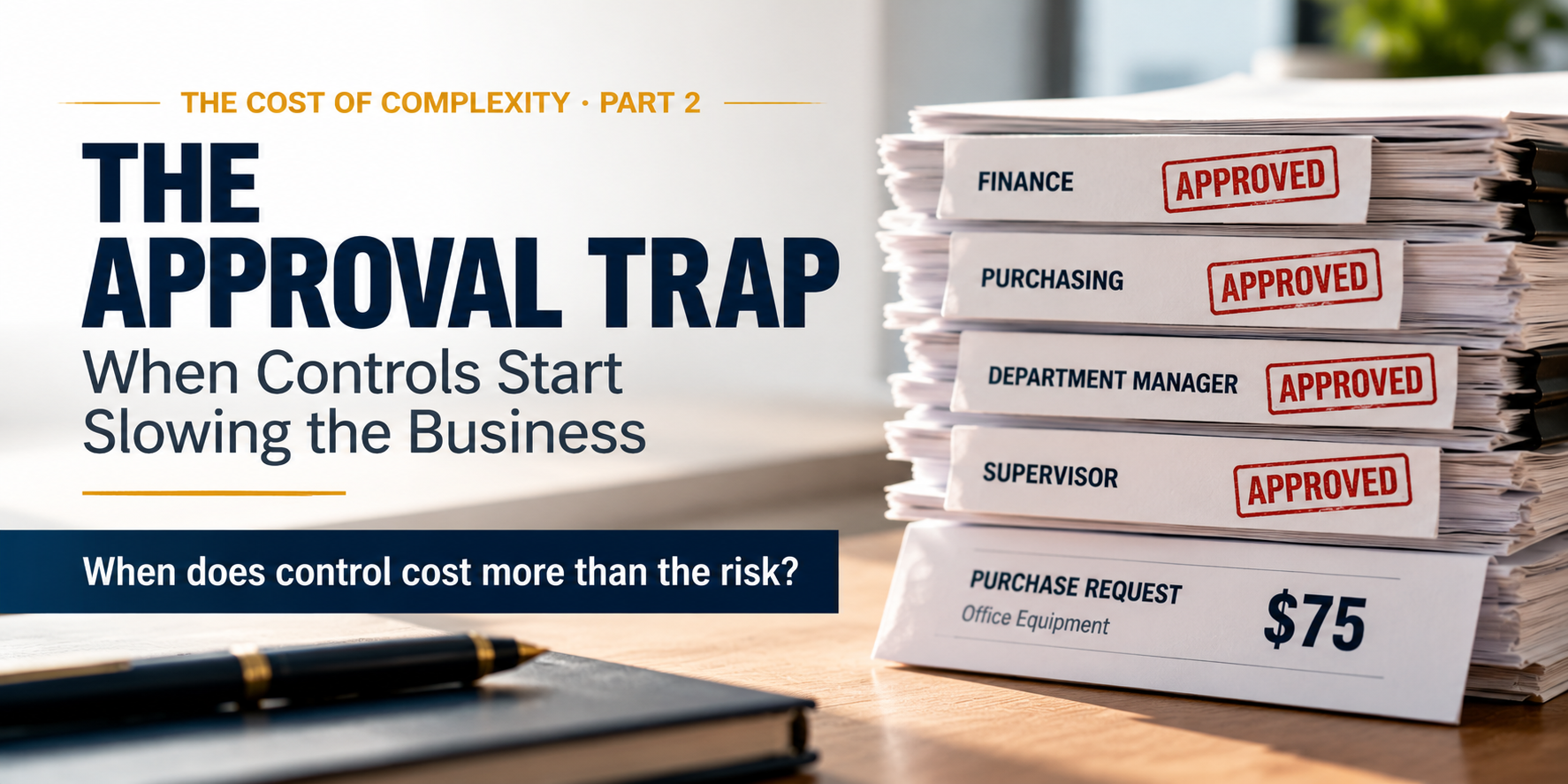
Much like the approval requirements we examined in Part 2, these arrangements often persist long after anyone has questioned whether they're still necessary.
Worse, once an exception becomes routine, it may stop being treated as an exception at all.
It becomes the way we do business with that customer.
And as similar arrangements multiply, the organization gradually loses the efficiency that standardized processes were designed to provide.
Why Leadership Often Misses the Problem
Customer exceptions can be difficult to challenge because they are frequently associated with revenue.
A salesperson may argue that the arrangement is necessary to retain the account.
Operations may hesitate to push back because customer satisfaction is a priority.
Finance may recognize additional costs but lack visibility into the operational details creating them.
And leadership may assume that a growing customer relationship is a profitable one.
The problem is not necessarily poor judgment by any individual.
It's a lack of shared visibility into the economics of the decision.
When revenue is measured in one department and the cost of delivering it is absorbed across several others, complexity can grow without accountability.
Five Questions Worth Asking
Before approving another special customer arrangement, ask:
- What does this exception actually require? Identify the additional work, systems, people, and coordination involved.
- What is the full cost to serve? Look beyond direct expenses to include labor, rework, scheduling disruptions, and administrative effort.
- Does the customer relationship justify the additional cost? Consider contribution margin, strategic value, and future opportunity – not revenue alone.
- Should we charge for the exception? Some customization creates value customers are willing to pay for.
- Is this truly an exception, or evidence that our standard offering needs to change? Repeated requests may reveal an opportunity to redesign the service rather than continually work around it.
These questions aren't intended to make a business less responsive.
They're intended to make responsiveness more deliberate – and more profitable.
Final Thought
The goal isn't to say no to customers.
It's to understand what saying yes really means.
Some exceptions strengthen relationships and create profitable differentiation.
Others consume capacity, increase operating costs, and make the business harder to manage.
And the most expensive exceptions may be the ones nobody remembers approving.
Customer flexibility should be a strategic choice – not an unmanaged operating expense.
Coming Next
Part 4: Why More Systems Don't Always Mean Better Information
We'll explore how organizations accumulate software, spreadsheets, reporting tools, and disconnected systems – often increasing complexity while making reliable information harder to obtain.
[Schedule a Strategy Alignment Session]
Are your customer relationships generating the profitability you expect?
Let's examine whether customer-specific processes, service commitments, and organizational complexity are quietly eroding margins.

Chris Scherer
Chris is a transformation leader with over 25 years of experience driving significant value and mitigating risks across a broad range of industries and functions. With a track record of generating more than $450 million in savings, he has excelled in both challenging and thriving environments within small businesses, mid-market firms, and Fortune 500 companies. A dual-degree graduate of Thunderbird and ESADE, Chris started his career at Arthur Andersen and progressed through roles from Corporate Audit to Global Human Resources at various Fortune 500 firms. He played a pivotal role in growing AArete, a global management consultancy, where he led initiatives that significantly reduced non-labor costs and improved compliance processes. An advocate for sustainable community initiatives, Chris was a founding member of a nonprofit focused on creating bicycle-friendly communities in New Jersey.