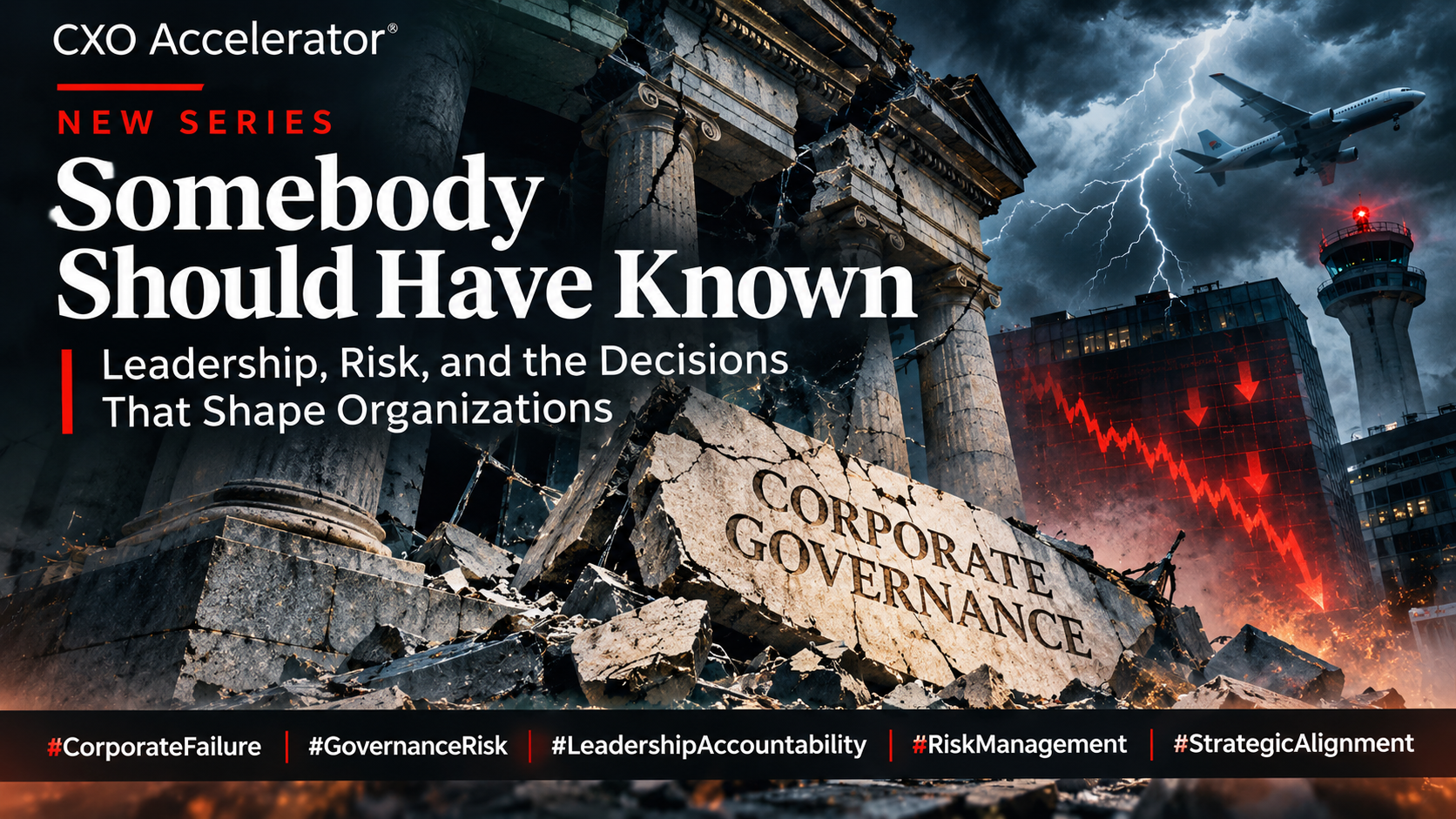
Somebody Should Have Known: Why Great Organizations Miss the Risks That Matter
Leadership, Risk, and the Decisions That Shape Organizations
How can one of the world's most successful technology companies become so dependent on a single leader that succession and governance become material strategic risks?
How can the U.S. air traffic control system experience serious disruptions when critical infrastructure problems have been identified for years?
How could Enron and Arthur Andersen – once among the most respected names in American business – collapse amid failures of financial reporting, professional judgment, and oversight?
And how could a major pharmaceutical company ship asthma inhalers that contained no medication?
These organizations operated in very different industries, under different circumstances, and with different outcomes.
But they raise a fundamental question:
Who knew - or should reasonably have known - about the risks? Who had the authority to act? And why didn't the organization respond before the consequences became unavoidable?
A Perspective Shaped by Experience
I've spent much of my career working inside and advising large, complex organizations.
At Arthur Andersen, I was part of an institution whose reputation rested on professional expertise, independence, and trust. Its collapse in 2002, following the Enron scandal, changed the accounting profession and helped accelerate a new era of corporate accountability.
At Baxter, beginning in 1996, I became familiar with COSO – the Committee of Sponsoring Organizations of the Treadway Commission – and its framework for internal controls and risk management.
At Schering-Plough, I worked in a global pharmaceutical environment where manufacturing quality, regulatory compliance, financial performance, and operational risk were critical to the business.
At McGraw-Hill, I worked extensively with Sarbanes-Oxley Section 404 documentation, process management, risk assessment, and security controls across corporate Finance and Human Resources.
Later, through more than a decade of consulting, I continued to encounter organizations with sophisticated processes and talented people, yet significant challenges connecting leadership, strategy, operations, and organizational performance.
These experiences shaped an important observation:
An organization can be very good at controlling individual processes without necessarily being aligned around the objectives that matter most.
The Framework That Should Be Fundamental to Every Organization
In 1992, COSO introduced its Internal Control – Integrated Framework, establishing a structured approach to internal control.
A decade later, following Enron, WorldCom, and other accounting scandals, Congress enacted the Sarbanes-Oxley Act of 2002.
Section 404 subsequently required public-company management to formally assess internal control over financial reporting, with external auditor attestation requirements applying to specified public companies.
These developments changed how organizations documented, evaluated, and reported financial controls.
But the underlying management principles extend far beyond financial reporting.
They begin with three questions:
1. Objectives: What are we trying to accomplish?
Before assessing risk, leadership must establish clear objectives. Those objectives should be understood throughout the organization and translated into meaningful responsibilities.
2. Risks: What could prevent us from achieving those objectives?
Risks may arise from financial reporting, operations, market conditions, technology, regulatory requirements, leadership decisions, organizational structure, or talent.
3. Controls: What are we doing to prevent, detect, or mitigate those risks?
Effective controls require clear ownership, appropriate resources, monitoring, and corrective action when something isn't working.
These questions are straightforward. Yet consistently applying them across an organization is anything but simple.
The Missing Link: From Controls to Strategy
My experience at McGraw-Hill illustrates an important distinction.
We had a substantial SOX 404 program, documented processes, risk assessments, and cross-functional coordination. In my roles supporting corporate Finance and HR, I worked with counterparts across business units and functions to help manage risks and controls.
But from my position, I did not have meaningful visibility into how the enterprise's highest-level strategic objectives translated into the work of our corporate functions.
We were managing risks within our responsibilities. What was less visible was how those responsibilities connected to the broader direction of the company.
That doesn't establish that McGraw-Hill lacked an effective strategy or governance structure. Its financial reporting controls received favorable independent assessments, and its later corporate separation was a strategic restructuring – not evidence by itself of a control failure.
But the experience raises a question that applies to organizations of every size:
Can people effectively manage the risks that matter most if they don't understand how their work connects to enterprise strategy?
Talent Is Part of the Risk Equation
The same challenge extends to people.
Human Resources can administer recruiting, compensation, benefits, employee relations, and compliance exceptionally well.
But those responsibilities are not the same as ensuring the organization has the right people, in the right roles, with the right capabilities to execute its strategy.
That requires business leaders to understand what the organization is trying to accomplish, what results each role must deliver, and what behaviors and capabilities are necessary for success.
HR plays an essential supporting role. But business leaders must own the alignment of talent with business objectives.
Otherwise, organizations risk managing employment processes effectively while overlooking the performance risks created by unclear roles, inadequate capabilities, or misaligned accountability.
Introducing: Somebody Should Have Known
This new CXO Accelerator series examines how organizations recognize, prioritize, and respond to the risks that threaten their most important objectives.
Through real-world cases, we'll explore what leaders knew, what they should reasonably have anticipated, who was accountable for decisions, and how organizational structures, incentives, and controls influenced the outcomes.
Some cases involve failures of oversight or accountability. Others involve operational breakdowns, competitive pressures, or major strategic transformations.
Not every crisis was preventable. Not every restructuring represents failure. And not every warning sign was as obvious beforehand as it appears in hindsight.
Our objective is to examine the evidence, distinguish facts from assumptions, and identify practical lessons leaders can apply within their own organizations.
We'll also explore the management disciplines behind those lessons – including COSO, Sarbanes-Oxley, SOX 404, enterprise risk management, strategic alignment, organizational accountability, and talent optimization.
The goal is not simply to understand what went wrong.
It's to understand how organizations can work better.
A Question Every Leader Should Be Asking
Whether you're responsible for a multinational corporation, a growing privately held business, or an individual department, consider these questions:
- Are our strategic objectives clearly defined and understood throughout the organization?
- Have we identified the risks that could prevent us from achieving them?
- Do we have effective controls and clear accountability for addressing those risks?
- Do we have the leadership capabilities, organizational structure, and talent needed to execute our strategy?
- When warning signs emerge, does someone have both the responsibility and authority to act?
These questions should not be reserved for auditors, compliance officers, or board members.
They belong in the everyday discipline of leadership.
And frankly, the underlying framework is something I believe people should begin learning in high school and certainly in college - long before they become responsible for managing an organization.
Because identifying a risk is only the beginning.
The real test of leadership is whether the organization understands the risk, assigns accountability, and acts.
What does your leadership team already know that it hasn't yet acted upon?
About CXO Accelerator
CXO Accelerator helps organizations align leadership, business strategy, and talent strategy to improve accountability, execution, profitability, and sustainable growth.
If your organization is growing but struggling to keep leadership, priorities, and people aligned, a Strategy Alignment Session can help identify where the gaps exist and what to address first.

Chris Scherer
Chris is a transformation leader with over 25 years of experience driving significant value and mitigating risks across a broad range of industries and functions. With a track record of generating more than $450 million in savings, he has excelled in both challenging and thriving environments within small businesses, mid-market firms, and Fortune 500 companies. A dual-degree graduate of Thunderbird and ESADE, Chris started his career at Arthur Andersen and progressed through roles from Corporate Audit to Global Human Resources at various Fortune 500 firms. He played a pivotal role in growing AArete, a global management consultancy, where he led initiatives that significantly reduced non-labor costs and improved compliance processes. An advocate for sustainable community initiatives, Chris was a founding member of a nonprofit focused on creating bicycle-friendly communities in New Jersey.