The Approval Trap: When Controls Start Slowing the Business
The Cost of Complexity – Part 2
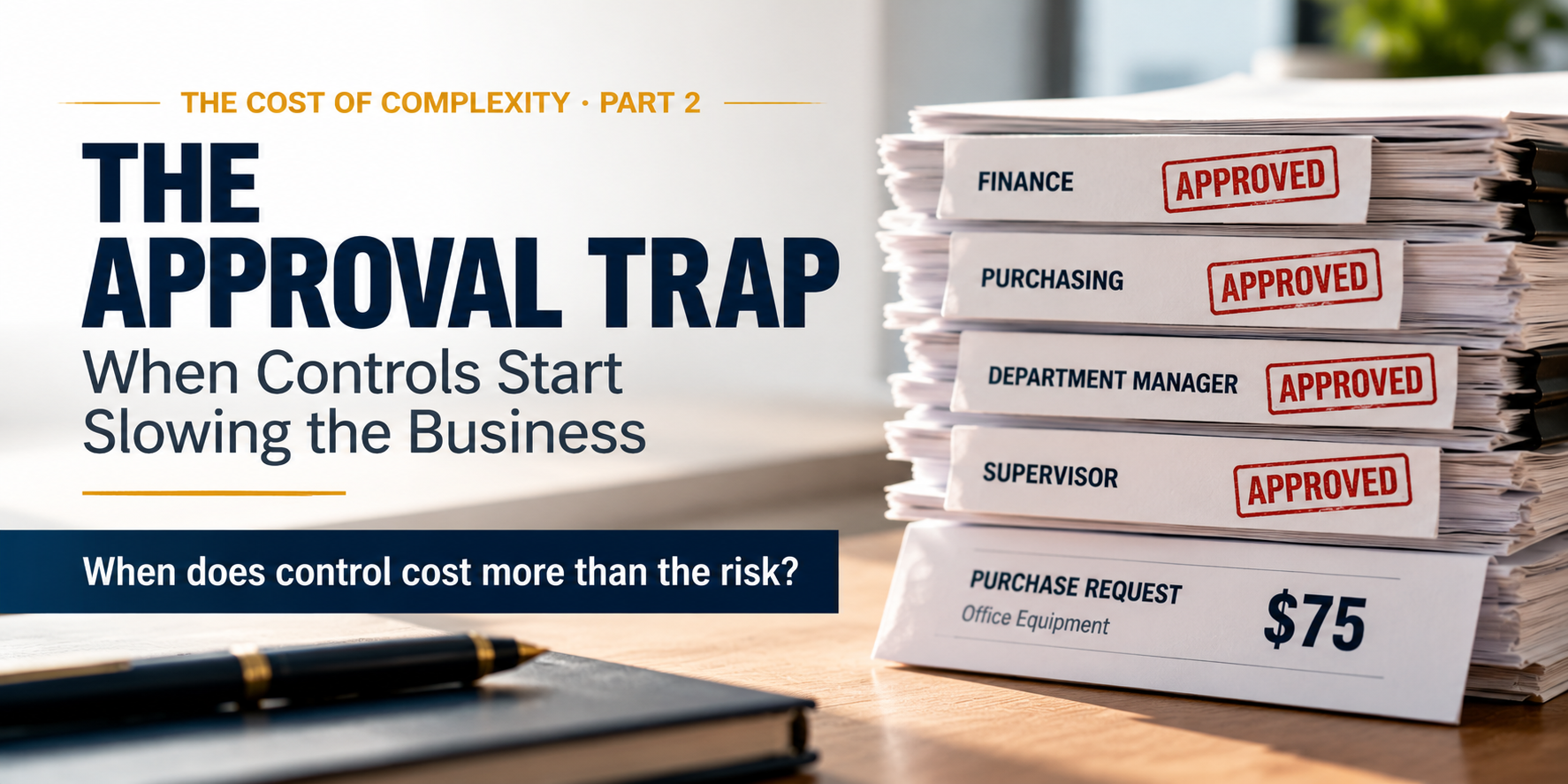
A $75 purchase shouldn't require $750 worth of management attention.
Yet in many organizations, that's exactly what happens.
An employee needs a replacement tool. The request goes to a supervisor, then a department manager, then purchasing, and finally finance.
By the time everyone has reviewed and approved it, the company may have spent more in management time than the item costs.
And the employee is still waiting.
No one intended to create an inefficient process.
Each approval was probably added for a good reason.
But somewhere along the way, the cost of controlling the decision began to exceed the risk of making it.
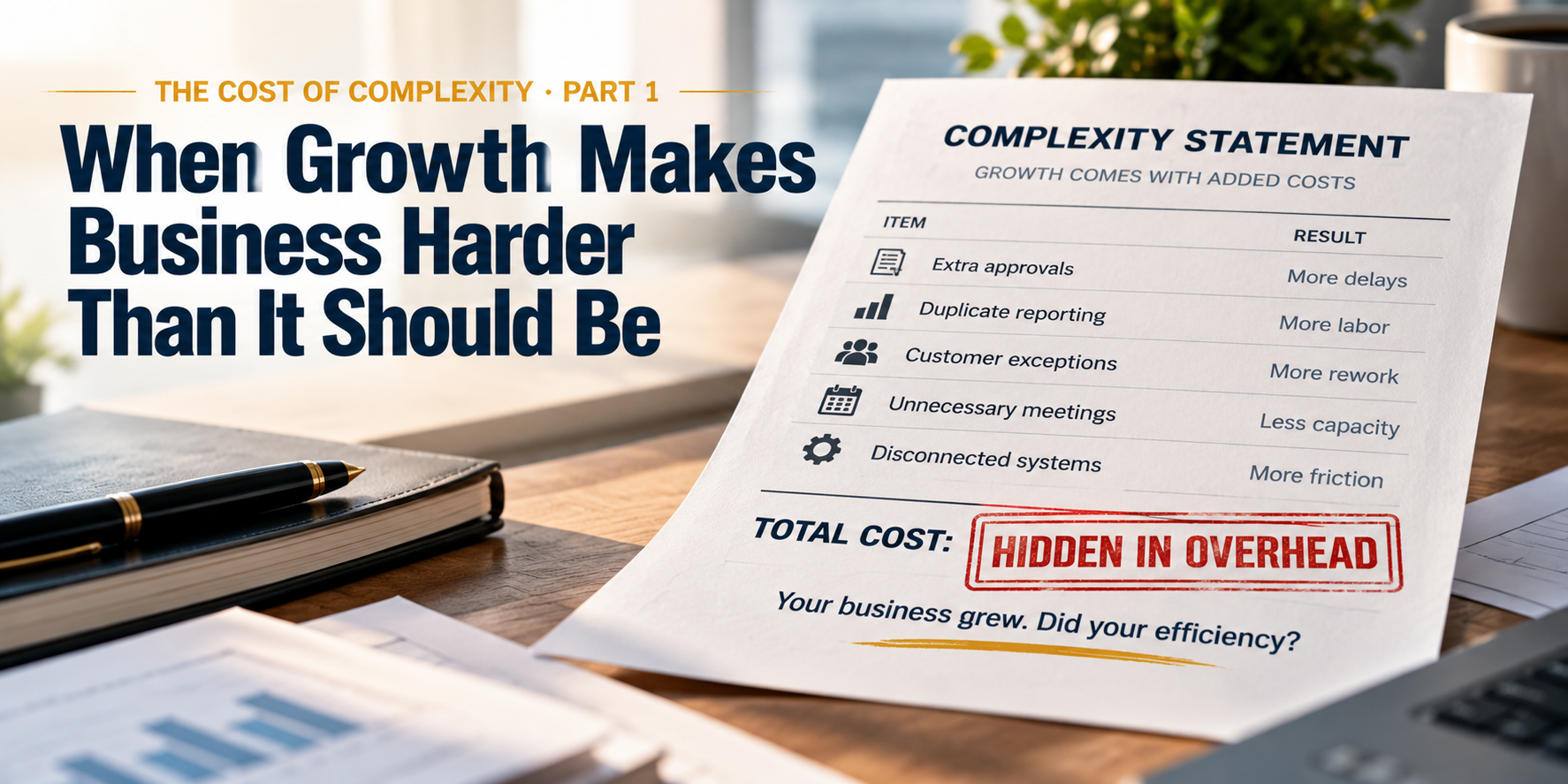
As we explored in Part 1, organizational complexity often accumulates one reasonable decision at a time.
How the Approval Trap Begins
Most approval requirements start with a legitimate concern.
An employee makes an unauthorized purchase.
A customer receives a discount that hurts profitability.
A department exceeds its budget.
A manager makes a decision without understanding the consequences.
Leadership responds by adding a safeguard.
From now on, purchases above a certain amount require approval.
Discounts need management authorization.
Exceptions must go through finance.
Each change seems reasonable.
The problem begins when these controls accumulate without anyone revisiting whether they're still necessary.
Soon, employees need permission for decisions they're perfectly capable of making.
Managers spend their days reviewing routine requests.
And executives become the final stop for decisions that should never have reached them – a familiar symptom of the leadership bottleneck, where routine decisions continue to depend on the person at the top.
The Cost Nobody Calculates
Imagine a $75 purchase requiring four approvals.
Suppose each reviewer spends just five minutes reading the request, checking details, and responding.
That's 20 minutes of management attention.
At an illustrative loaded labor cost of $90 per hour, the review time alone costs $30.
That doesn't include the employee preparing the request, following up, or waiting to complete the work.
Nor does it include the interruptions that pull managers away from more important responsibilities.
The approval process may still be justified if it prevents a meaningful risk.
But if it doesn't, the organization is paying a recurring cost for little corresponding benefit.
An approval isn't free simply because nobody sends an invoice for it.
As we examined in our earlier discussion of the hidden cost of small decisions, even routine approvals can consume valuable leadership capacity.
When Control Creates More Risk
Here's the irony.
Excessive approvals can weaken the very control they're intended to provide.
When managers approve dozens of routine requests every day, reviewing becomes a habit rather than an exercise in judgment.
People begin clicking "Approve" because the request looks familiar.
Employees learn how to navigate the process instead of learning how to make sound decisions.
And when everyone has signed off, accountability becomes harder to locate.
Who actually owns the outcome?
The employee who requested it?
The manager who approved it?
The executive who gave the final authorization?
More signatures don't necessarily produce better decisions.
Sometimes they simply distribute responsibility so widely that nobody feels fully accountable.
Approval Authority Should Match the Risk
The solution isn't to eliminate controls.
It's to make them proportionate.
A routine purchase within an approved budget shouldn't necessarily require the same scrutiny as a major capital investment.
A standard customer discount shouldn't follow the same approval path as an exception that could materially damage margins.
And a reversible operational decision shouldn't require the same authorization as one with significant legal, financial, or safety consequences.
This is where delegating decisions rather than just tasks becomes essential: employees need both the responsibility and the authority to act within clearly defined boundaries.
Effective organizations distinguish between decisions based on factors such as:
- Financial exposure: How much is genuinely at risk?
- Reversibility: Can the decision be corrected without major consequences?
- Frequency: Is this routine or unusual?
- Capability: Does the person making the decision have the knowledge and judgment required?
- Compliance: Is independent review necessary to satisfy legal, regulatory, or internal-control requirements?
These distinctions help leaders preserve meaningful safeguards while removing unnecessary friction.
Five Questions for Your Leadership Team
Before adding another approval – or keeping an existing one – ask:
- What specific risk is this approval intended to prevent?
- How often does that risk actually occur, and how costly could it be?
- Does the person approving the request have information or judgment the requester lacks?
- Could clear guidelines, spending limits, training, or exception reporting provide comparable protection?
- When did we last review whether this approval was still necessary?
The answers can expose controls that have outlived their original purpose.
They can also reveal opportunities to move decisions closer to the people with the information needed to make them.
That doesn't mean abandoning oversight.
It means designing oversight around the decisions that deserve it.
Final Thought
Every approval should serve a purpose.
Some protect the business from significant financial, operational, or compliance risks.
Others exist because someone added them years ago and nobody questioned them afterward.
The difference matters.
Because when every decision requires permission, leaders don't necessarily gain control.
They may simply gain more work.
The goal isn't fewer approvals at any cost.
It's the right approvals, at the right level, for the right reasons.
Coming Next
Part 3: The Customer Exception That Became Everyone's Problem
We'll examine how special arrangements made to win or retain customers can quietly create operational costs that undermine the profitability of those relationships.
[Schedule a Strategy Alignment Session]
Are your approval processes protecting the business – or slowing it down?
Let's identify where decision authority, accountability, and operational controls may be creating unnecessary complexity.

Chris Scherer
Chris is a transformation leader with over 25 years of experience driving significant value and mitigating risks across a broad range of industries and functions. With a track record of generating more than $450 million in savings, he has excelled in both challenging and thriving environments within small businesses, mid-market firms, and Fortune 500 companies. A dual-degree graduate of Thunderbird and ESADE, Chris started his career at Arthur Andersen and progressed through roles from Corporate Audit to Global Human Resources at various Fortune 500 firms. He played a pivotal role in growing AArete, a global management consultancy, where he led initiatives that significantly reduced non-labor costs and improved compliance processes. An advocate for sustainable community initiatives, Chris was a founding member of a nonprofit focused on creating bicycle-friendly communities in New Jersey.