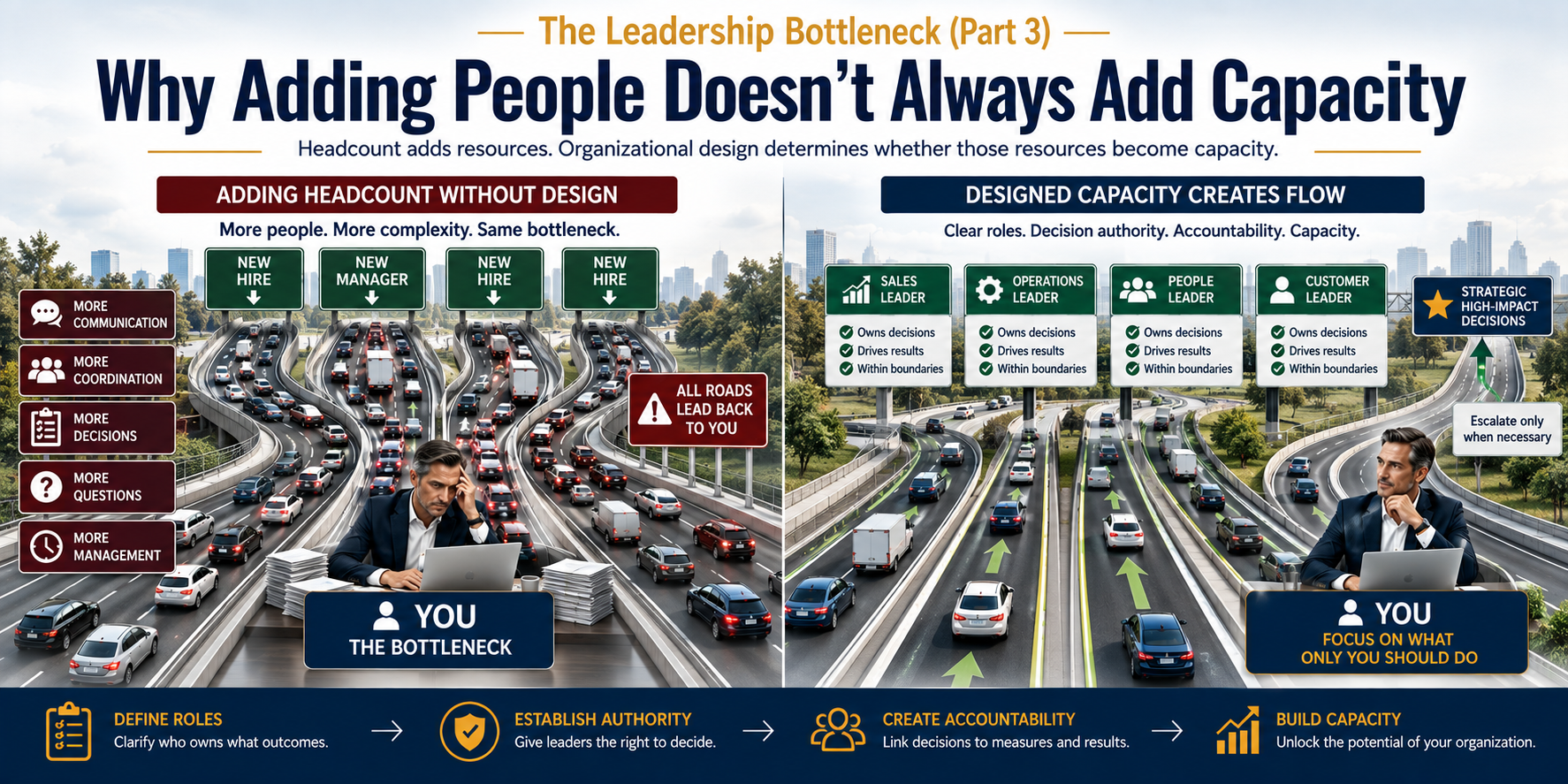
A $50 decision probably costs about $50.
Unless the wrong person is making it.
Imagine a senior executive spending 30 minutes reviewing a relatively minor purchase.
The expense may be insignificant.
But the real cost isn't the purchase.
It's the leadership capacity consumed by the decision.
And across a growing organization, those costs add up quickly.
Not All Decisions Cost What They Appear to Cost
We tend to evaluate decisions by their visible financial impact.
A $500 purchase gets more attention than a $50 purchase.
A $50,000 investment gets more scrutiny still.
That makes sense.
But there's another cost that's much harder to see:
Who has to be involved?
Consider a routine decision that moves through:
Employee → Manager → Director → Executive
Each person reads the email.
Asks questions.
Provides context.
Waits for a response.
Perhaps attends a meeting.
The original decision might involve very little money.
But the organization has now spent far more than the apparent value of the decision – in time, attention, delay, and opportunity cost.
The Most Expensive Resource May Be Leadership Attention
Senior leaders have finite capacity.
Every hour spent deciding:
- Routine purchases.
- Scheduling issues.
- Minor customer exceptions.
- Small pricing adjustments.
- Everyday personnel questions.
- Operational details.
...is an hour that can't be spent elsewhere.
And the opportunity cost can be significant.
Because senior leadership should be spending disproportionate time on things such as:
- Strategy.
- Major customers.
- Leadership development.
- Resource allocation.
- Competitive threats.
- New opportunities.
- Organizational capability.
- Decisions with significant or lasting consequences.
The problem isn't that executives are incapable of making small decisions.
They're often exceptionally good at them.
That's partly why those decisions keep finding them.
Being the Best Person Doesn't Mean You Should Be the Person
This is an important leadership transition.
An experienced owner may be able to solve a problem faster than anyone else.
They've seen it before.
They know the customer.
They understand the history.
They can make the decision in five minutes.
So they do.
But if every difficult decision automatically goes to the person most capable of solving it, something happens:
Everyone else's decision-making capability develops more slowly.
The leader becomes more indispensable.
And the organization becomes more dependent.
Think About Decision Value
A useful way to examine leadership time is to ask two questions:
1. How consequential is this decision?
and
2. What is the lowest appropriate level at which it can be made well?
That second question matters.
We're not trying to push every decision downward.
We're trying to place decisions where the necessary information, judgment, authority, and accountability can reasonably exist.
A frontline employee might resolve one issue.
A manager another.
A senior executive another.
The objective isn't decentralization for its own sake.
It's appropriate decision placement.
The Hidden Cost Is What Didn't Happen
Suppose a CEO spends two hours resolving operational issues that could appropriately have been handled elsewhere.
The cost isn't simply two hours of executive compensation.
What didn't happen during those two hours?
Perhaps the CEO didn't:
- Call an important customer.
- Develop a key leader.
- Evaluate a strategic opportunity.
- Address an emerging risk.
- Improve a critical process.
- Think about where the business needs to be next year.
Those things rarely arrive marked URGENT.
That's exactly why operational decisions can crowd them out.
Audit Your Decisions, Not Just Your Calendar
Most leaders have reviewed their calendars looking for wasted time.
Try something different.
For one week, keep track of the decisions that reach you.
For each one, ask:
Did this decision require my role – or simply my experience?
Then ask:
What would need to be true for someone else to make this decision well next time?
Perhaps they need:
- Better information.
- Clearer authority.
- Defined financial limits.
- Stronger skills.
- Better measures.
- More context.
Those are solvable problems.
And solving them creates capacity that deleting another meeting from your calendar never will.
Final Thought
The cost of a decision isn't just the dollars involved.
It's also the organizational capacity required to make it.
A small decision made at the wrong level can be surprisingly expensive.
And when hundreds of those decisions accumulate, leaders can spend their days doing work they're extremely capable of doing...
while the work only they can do waits.
The objective isn't to make fewer decisions.
It's to make sure the right decisions reach the right level.
Coming Next
Part 5: When Your Best Problem-Solver Becomes the Problem
📅 [Schedule a Strategy Alignment Session]
Let's determine whether leadership capacity is being spent on the decisions that create the greatest value – or consumed by decisions that belong elsewhere.