“We need more people.”
Maybe.
When a business is overloaded, adding people seems like the obvious solution.
More customers require more people.
More projects require more people.
More work requires more people.
And sometimes, that's exactly right.
But there's an important question to ask first:
Is the organization short on people – or short on capacity?
They're not necessarily the same thing.
More People Can Create More Work
Every new person brings potential capacity.
They also bring:
- Communication.
- Coordination.
- Training.
- Management.
- Decisions.
- Questions.
- Handoffs.
If the organization is well designed, those costs are outweighed by the capacity the person creates.
If it isn't, something very different can happen.
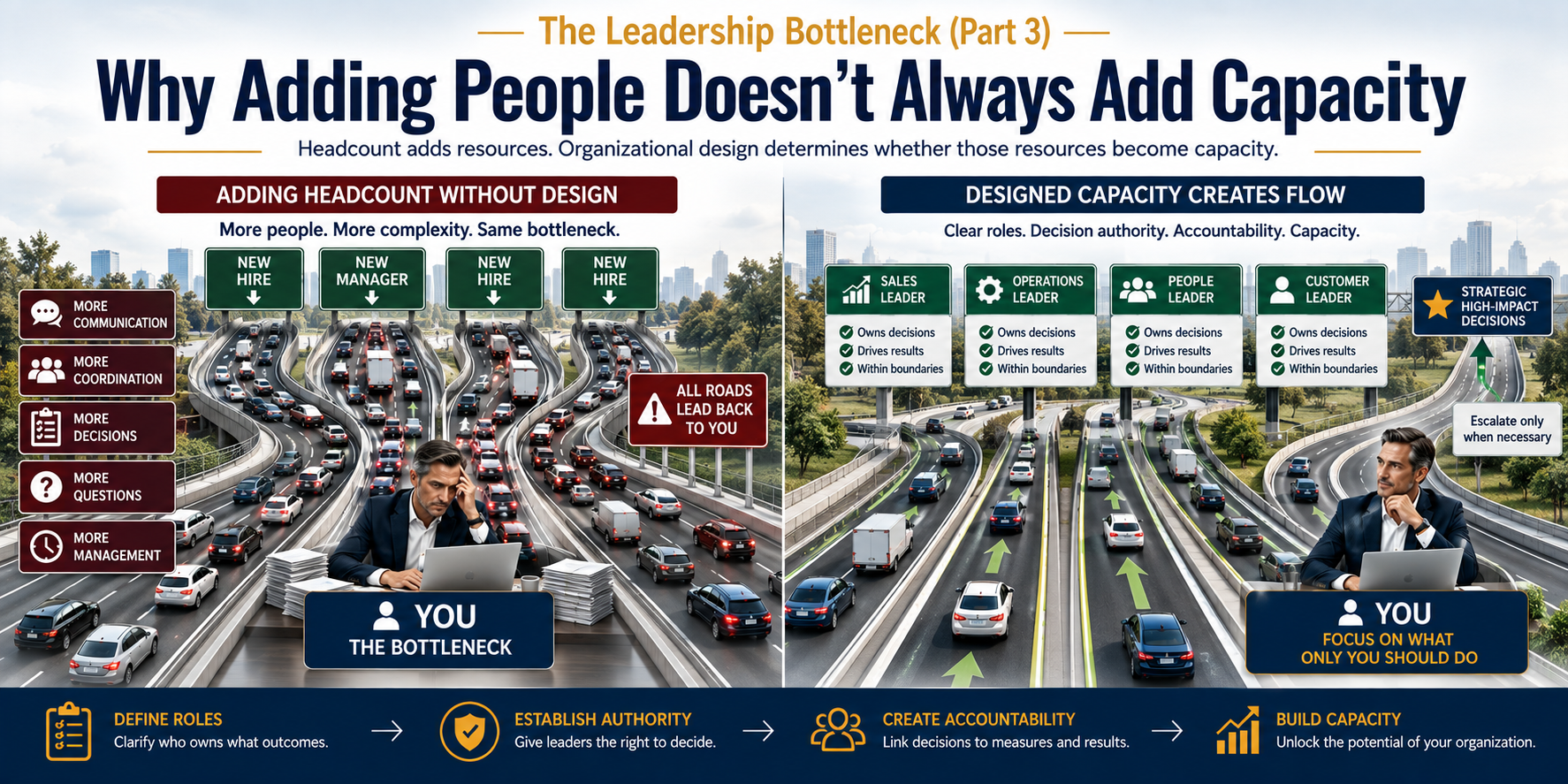
The organization gets bigger...
without becoming more capable.
Watch Where the Work Goes
Imagine adding three managers to relieve an overloaded executive.
On paper, leadership capacity just increased.
But what if those managers:
- Don't know which decisions they own?
- Have overlapping responsibilities?
- Need approval for routine exceptions?
- Measure success differently?
- Routinely escalate issues upward?
You've added three people.
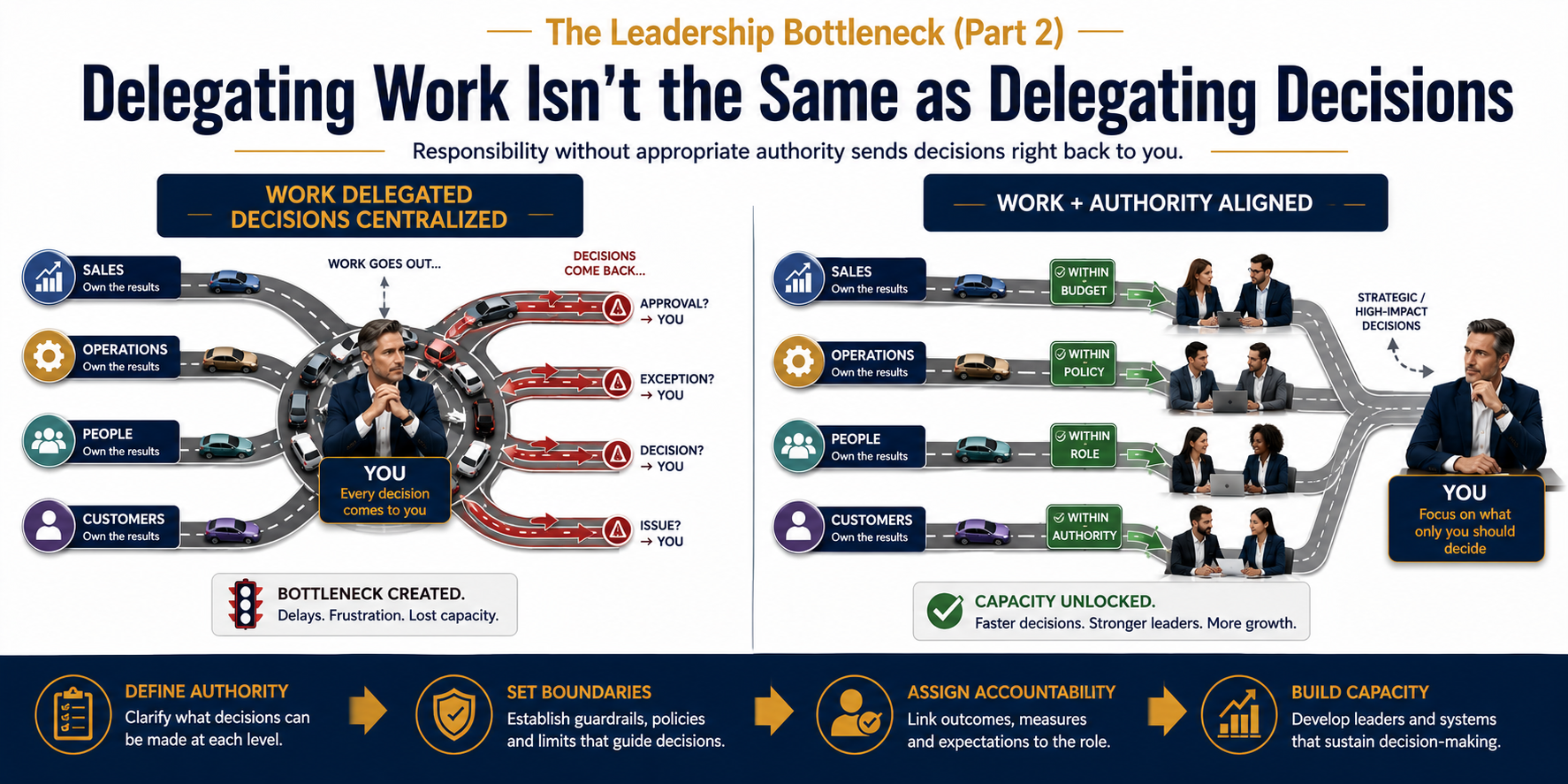
But you've potentially also added three new streams of questions and decisions flowing back to the same executive.
The bottleneck didn't disappear.
You added traffic to it.
Headcount Isn't Capacity
This distinction matters.
Headcount tells you how many people you have.
Capacity tells you how much useful work the organization can accomplish.
Those aren't interchangeable.
A ten-person team with clear roles, authority, processes, and accountability may accomplish more than a fifteen-person team without them.
That's why simply asking:
“Do we need another person?”
can be the wrong starting point.
A better question is:
“What's preventing the people we already have from producing more value?”
Look Upstream Before Hiring Downstream
Before adding another position, examine what is creating the workload.
Is someone genuinely at capacity?
Or is time being consumed because:
- Decisions take too long?
- Work gets redone?
- Responsibilities overlap?
- Too many approvals are required?
- Meetings substitute for clear ownership?
- Problems repeatedly escalate?
- Processes contain unnecessary handoffs?
If those are the constraints, another person may treat the symptom without removing the cause.
Worse, the new hire becomes part of the same system.
Sometimes You Absolutely Need More People
This isn't an argument against hiring.
A growing organization eventually needs additional talent.
The question is when.
If demand exceeds the productive capacity of a well-designed role or process, adding the right person can unlock tremendous value.
But if the constraint is structural, hiring into it can make the structure more expensive without making it substantially better.
That's an important difference.
Capacity Is Designed
Real organizational capacity comes from combining the right:
People + Roles + Authority + Processes + Measures
When those elements reinforce one another, adding a person can multiply capacity.
When they don't, adding a person may simply multiply complexity.
And that means the leader remains involved in:
- More conversations.
- More decisions.
- More coordination.
- More problem-solving.
Exactly the opposite of what the hire was supposed to accomplish.
A Question Before the Next Hire
The next time someone says:
“We need another person.”
Ask:
“What specifically will this person enable us to accomplish that we cannot accomplish today – and what's preventing us from doing it now?”
The answer may confirm the need for another employee.
Great.
But it may uncover something more valuable:
A process problem.
An authority problem.
A role problem.
An accountability problem.
Or a leadership bottleneck.
Final Thought
Growth often requires more people.
But more people don't automatically create more capacity.
Headcount adds resources. Organizational design determines whether those resources become capacity.
Before adding another person to an overloaded organization, make sure you're not simply adding another lane of traffic to the same bottleneck.
Coming Next
Part 4: The $50 Decision That Costs $5,000
📅 [Schedule a Strategy Alignment Session]
Let's determine whether your organization needs more people – or whether the people you already have are constrained by roles, processes, authority, or accountability.