Over the past several articles in this series, we’ve examined a pattern many businesses are beginning to experience.
Revenue grows.
Demand remains strong.
But profitability becomes increasingly difficult to maintain.
Economists like Brian Beaulieu of ITR Economics have warned about this dynamic for years. Between rising labor costs, inflation pressures, and structural inefficiencies inside organizations, many businesses will experience what he calls profitless prosperity.
Topline growth without corresponding margin strength.
In earlier articles we explored several contributors:
- Growth alone does not protect profitability
- Cost structures quietly expand during good times
- Pricing increases only go so far
- Execution discipline determines operational efficiency
- Strategy without cost awareness creates fragility
- Hiring more people rarely fixes structural margin problems
But there is a deeper issue underlying all of these.
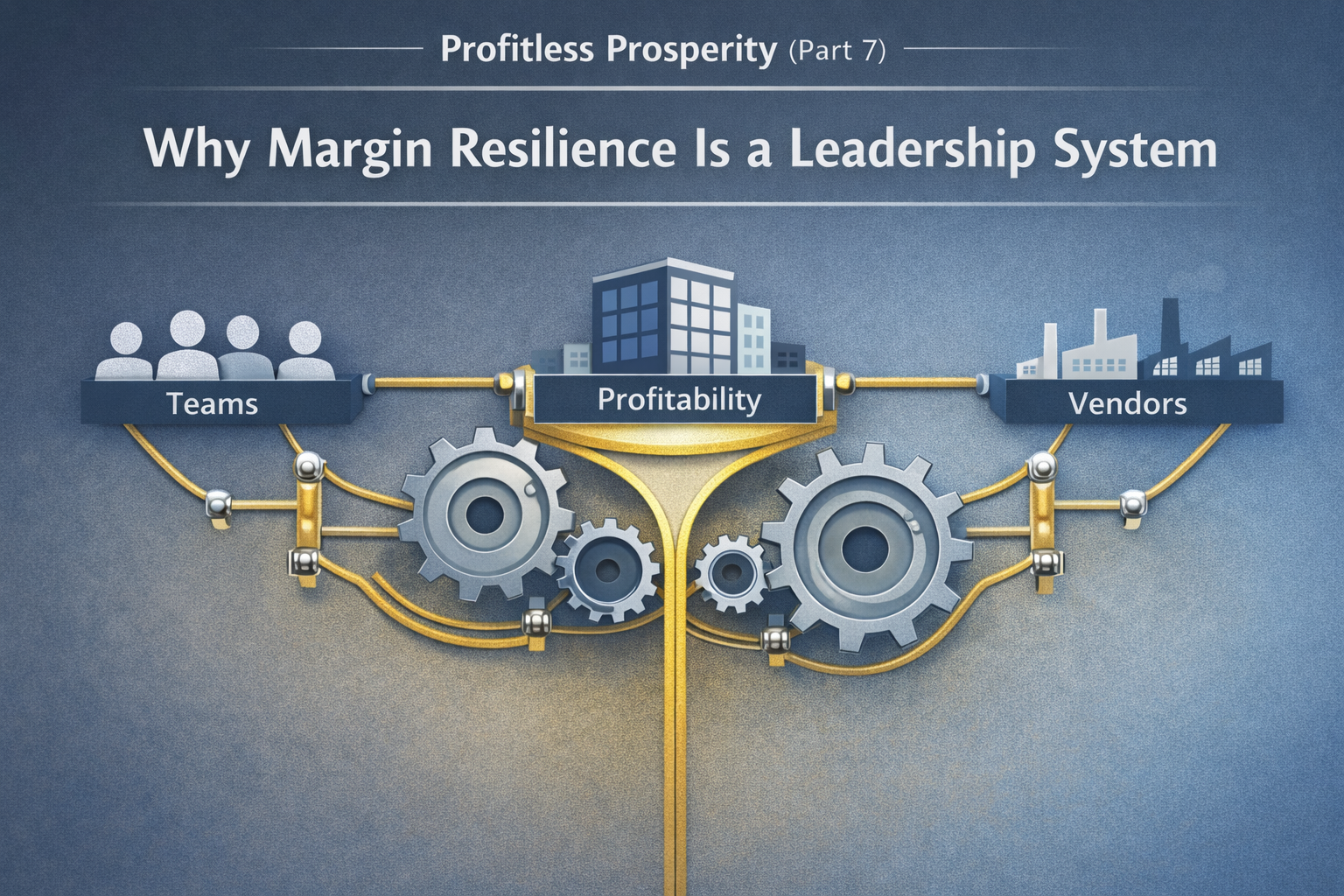
Profitability is not the result of isolated decisions.
It is the result of a leadership system.
Margin Problems Are Almost Never Single Decisions
When margins deteriorate, leaders often search for a specific cause:
- A vendor charging too much
- Labor costs rising
- Inefficient processes
- Pricing pressure from competitors
While these factors matter, they rarely explain the whole story.
More often, margin erosion happens when organizations lack a coherent leadership system that governs how work is designed, negotiated, and executed.
Without that system:
- Costs accumulate gradually
- Vendor relationships become reactive
- Employees inherit unclear expectations
- Customers demand exceptions
- Operational complexity grows unnoticed
Individually, each decision appears manageable.
Collectively, they quietly compress margins.
The Real Discipline Is Structural
Companies that maintain strong margins over time tend to operate differently.
They do not rely on occasional cost-cutting efforts.
They build systems that continuously reinforce profitability.
These systems typically include:
Clear operational expectations
Every function understands what “good execution” looks like.
Defined roles and responsibilities
Ambiguity is reduced between leaders, teams, vendors, and partners.
Mutual accountability with vendors and customers
Strong organizations negotiate agreements that define expectations on both sides – not just price.
Structured decision frameworks
Leaders evaluate investments, headcount, and operational changes through a profitability lens.
In other words, profitability becomes a designed outcome, not a lucky result.
Negotiation Is Often Where Profitability Is Won or Lost
One of the most overlooked aspects of margin resilience is the way organizations structure their external relationships.
Many businesses treat vendor and partner negotiations as isolated transactions.
But effective leaders recognize something different:
The agreement itself defines how work will function going forward.
Strong organizations often formalize these expectations through documents that outline:
- Roles and responsibilities
- Service expectations
- Measures of success
- Accountability mechanisms
Sometimes these are called Memoranda of Understanding or similar agreements.
Their purpose is simple:
Prevent problems before they occur by ensuring both sides understand how success will be measured.
Without that clarity, organizations often discover problems only after they become costly.
Margin Resilience Is Built Before Disruption
Economic disruption exposes weaknesses that were already present.
Companies with weak leadership systems often struggle when:
- Labor costs rise
- Supply chains tighten
- Vendors push back on pricing
- Demand fluctuates
Organizations with strong leadership systems adapt more effectively because their structure already reinforces:
- cost discipline
- operational clarity
- aligned incentives
The difference is rarely luck.
It is preparation.
The Leadership Question
For most organizations, the most important question is not:
“Where can we cut costs?”
The better question is:
“Do we have a leadership system designed to protect margins over time?”
Because when margin discipline is built into the way an organization operates, profitability becomes far more resilient – even during economic volatility.
📅 [Schedule a Strategy Alignment Session]
Let’s determine whether your company is positioned for profitable growth — or drifting toward profitless prosperity.
In the Final Article
In the final article of this series, we’ll examine a broader question:
Which companies are most likely to thrive during the economic volatility expected over the next decade – and why.