Economic pressure doesn’t usually destroy organizations overnight.
It exposes the weaknesses that were tolerated during good times.
Margins tighten.
Labor costs rise.
Customers push back on pricing.
Vendors renegotiate.
And then something more damaging happens:
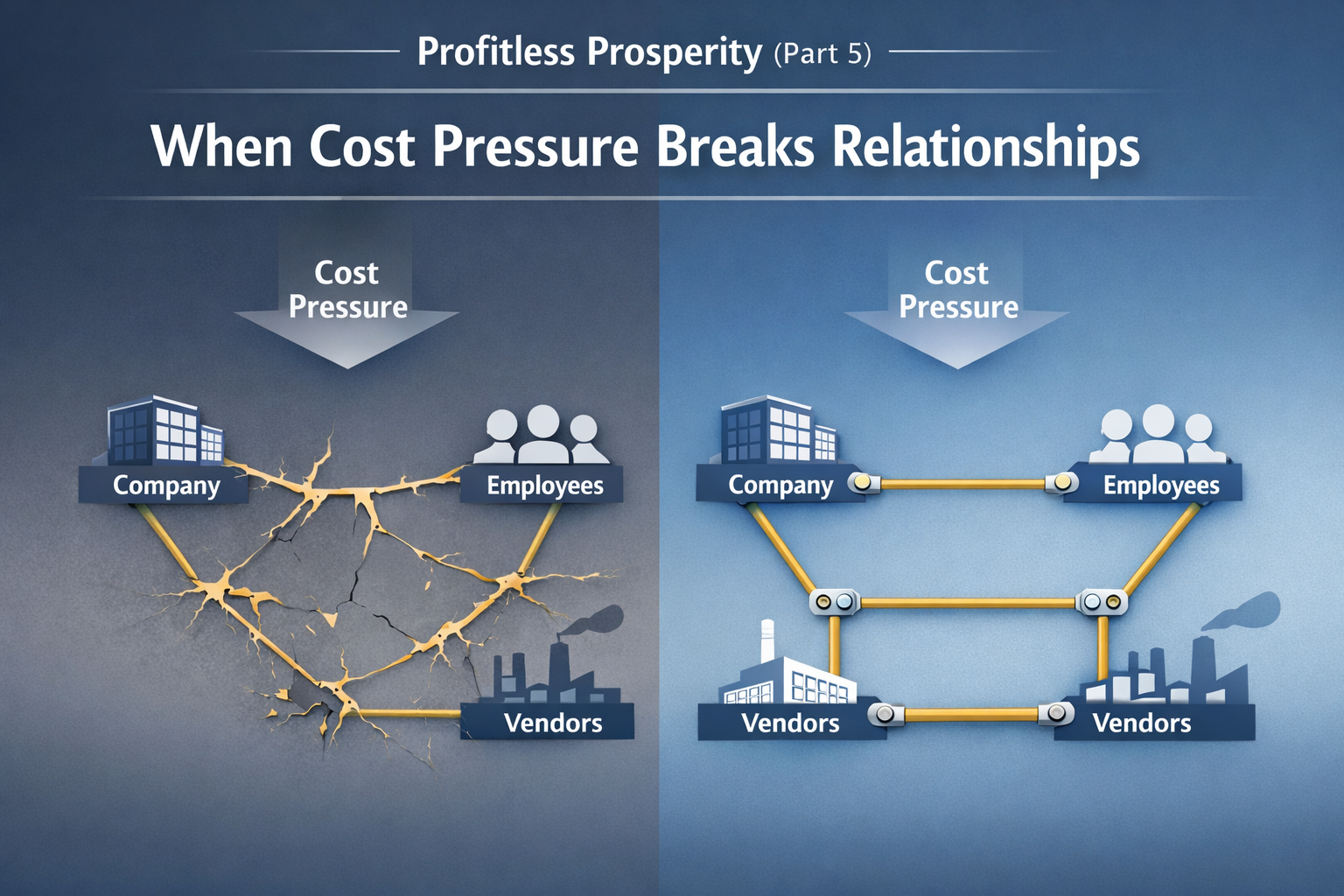
Relationships begin to fracture.
The Hidden Cost of Margin Pressure
When organizations feel squeezed, they often respond by:
- Tightening internal controls
- Renegotiating contracts aggressively
- Delaying vendor payments
- Pushing productivity harder
- Passing cost increases downstream
Each action may be rational in isolation.
Collectively, they change the tone of the system.
Employees absorb ambiguity.
Vendors protect themselves.
Customers feel instability.
What was once collaborative becomes transactional.
And transactional systems fail under stress.
A Recent Example We Experienced Personally
Earlier this year, severe winter weather disrupted air travel across the country. We were directly impacted –multiple cancellations, extended delays, and ultimately a four-day drive from Phoenix to Michigan due to cascading breakdowns in service reliability.
Weather was the trigger.
But weather alone doesn’t create systemic collapse.
Breakdowns occur when (see here: AA Operations Still Snarled):
- Staffing models lack resilience
- Crew agreements strain under pressure
- Systems optimize for efficiency over redundancy
- Communication deteriorates under load
When cost structures are optimized too tightly, there is no buffer left for volatility.
Employees become the shock absorbers.
Customers experience the consequences.
Margin optimization, if not designed carefully, becomes fragility.
Where Most Leaders Miscalculate
Under pressure, leaders often assume:
“If we just reduce cost fast enough, we’ll stabilize.”
But when cost action undermines relationship stability, you create second-order effects:
- Vendor disengagement
- Employee distrust
- Customer churn
- Operational inconsistency
These costs don’t appear immediately on financial statements.
They show up later as volatility.
The Difference Between Cost Cutting and Relationship Design
Organizations that avoid this pattern approach margin pressure differently.
They design agreements that hold under strain.
That includes:
- Clearly defined roles and responsibilities
- Explicit service expectations
- Measurable outcomes
- Accountability mechanisms on both sides
- Escalation paths before disruption cascades
These agreements often take months – sometimes years – to refine.
They are not transactional documents.
They are operational governance systems.
When volatility hits, these systems absorb shock rather than amplify it.
Why This Matters Before the 2030s
ITR Economics projects increased volatility and structural pressure as we move toward the next decade.
The leaders who navigate that period successfully will not be those who cut fastest.
They will be those who:
- Preserve trust while protecting margin
- Clarify expectations before stress rises
- Build buffers intentionally
- Govern relationships proactively
Economic disruption does not reward fragility.
It rewards design.
What Comes Next
In Part 6, we’ll explore the final tension leaders must confront:
Why hiring more people during growth often accelerates profitless prosperity – and how leadership capacity determines whether margin discipline survives scale.
📅 [Schedule a Strategy Alignment Session]
Let’s determine whether your key relationships are designed to hold under economic pressure.