When margins start to erode, the reflexive response is predictable.
Leaders ask for reports.
Finance tightens controls.
Budgets get scrutinized.
And yet, costs continue to creep back in.
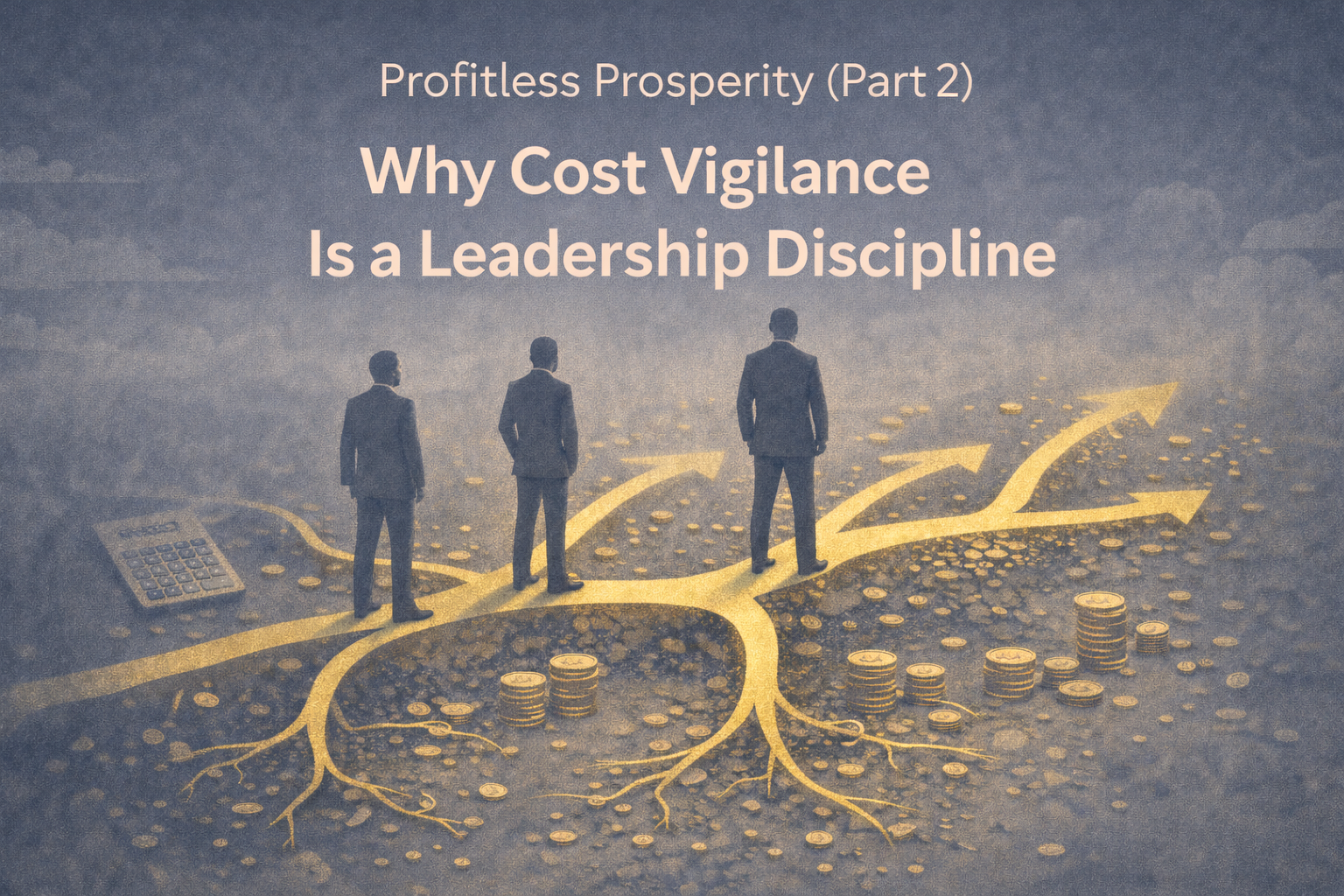
Not because finance missed something – but because cost vigilance was never a finance problem to begin with.
It’s a leadership one.
The Dangerous Myth About Cost Control
Many organizations treat cost discipline as:
- A budgeting cycle
- A procurement exercise
- A spreadsheet problem
In reality, costs don’t rise because numbers are wrong.
They rise because decisions compound over time.
Exceptions get approved.
Service expectations expand quietly.
Customization becomes normalized.
Relationships drift from structured to transactional.
None of this shows up as a single bad decision.
It shows up as permission.
Where Cost Actually Gets Created
In our work, margin erosion almost always traces back to leadership behavior, not accounting failures.
Costs increase when:
- Roles and responsibilities are loosely defined
- Accountability ends when agreements are signed
- Vendors optimize for their outcomes, not shared ones
- Employees absorb ambiguity instead of clarity
- Leaders step in reactively instead of governing proactively
These conditions don’t feel like cost problems in the moment.
They feel like:
“We’ll deal with it later.”
Later is when profitless prosperity shows up.
Why “Good Times” Are the Most Dangerous
Economic insulation – whether from tariffs, strong demand, or limited competition – often masks inefficiency.
ITR Economics warned explicitly:
“Tariffs protect inefficiencies, but the day will come when they are removed.”
When pressure is low:
- Leaders stop pushing for clarity
- Cost creep feels manageable
- Structural weaknesses stay hidden
But when conditions change, those same weaknesses amplify.
Cost vigilance that only appears during downturns is already too late.
Cost Discipline Lives in Agreements, Not Policies
Organizations that protect margins over time do something different.
They don’t rely on:
- Policies
- One-time negotiations
- Or heroic intervention
They rely on designed accountability.
That means:
- Negotiations conducted over months or years – not events
- Clear definitions of who owns what
- Service expectations that persist after signature
- Measures of success visible to both sides
- Repercussions defined before bad outcomes occur
Often, this work results in a Memorandum of Understanding or Agreement – but the document is only the artifact.
The real value is the discipline behind it.
The Cost of Getting This Wrong
When leadership abdicates cost vigilance to finance:
- Employees become the shock absorbers
- Vendors protect their margins at your expense
- Customers experience inconsistency
- Leaders lose visibility until failure becomes public
Cost doesn’t disappear.
It just changes form.
What Cost Vigilance Looks Like When It’s Working
When cost discipline is treated as a leadership responsibility:
- Expectations are explicit
- Tradeoffs are deliberate
- Exceptions are intentional – not habitual
- Relationships hold under pressure
- Margins stabilize even when conditions worsen
This is how organizations avoid profitless prosperity – not by cutting harder, but by governing better.
What Comes Next
In Part 3, we’ll tackle the pressure point leaders are least prepared for:
Why inflation, labor shortages, and rising wages will break organizations that haven’t redesigned how value is delivered – and why pass-through pricing alone won’t save you.
📅 [Schedule a Strategy Alignment Session]
If margin pressure keeps resurfacing despite cost initiatives, let’s determine whether leadership discipline – not finance – is the missing control.