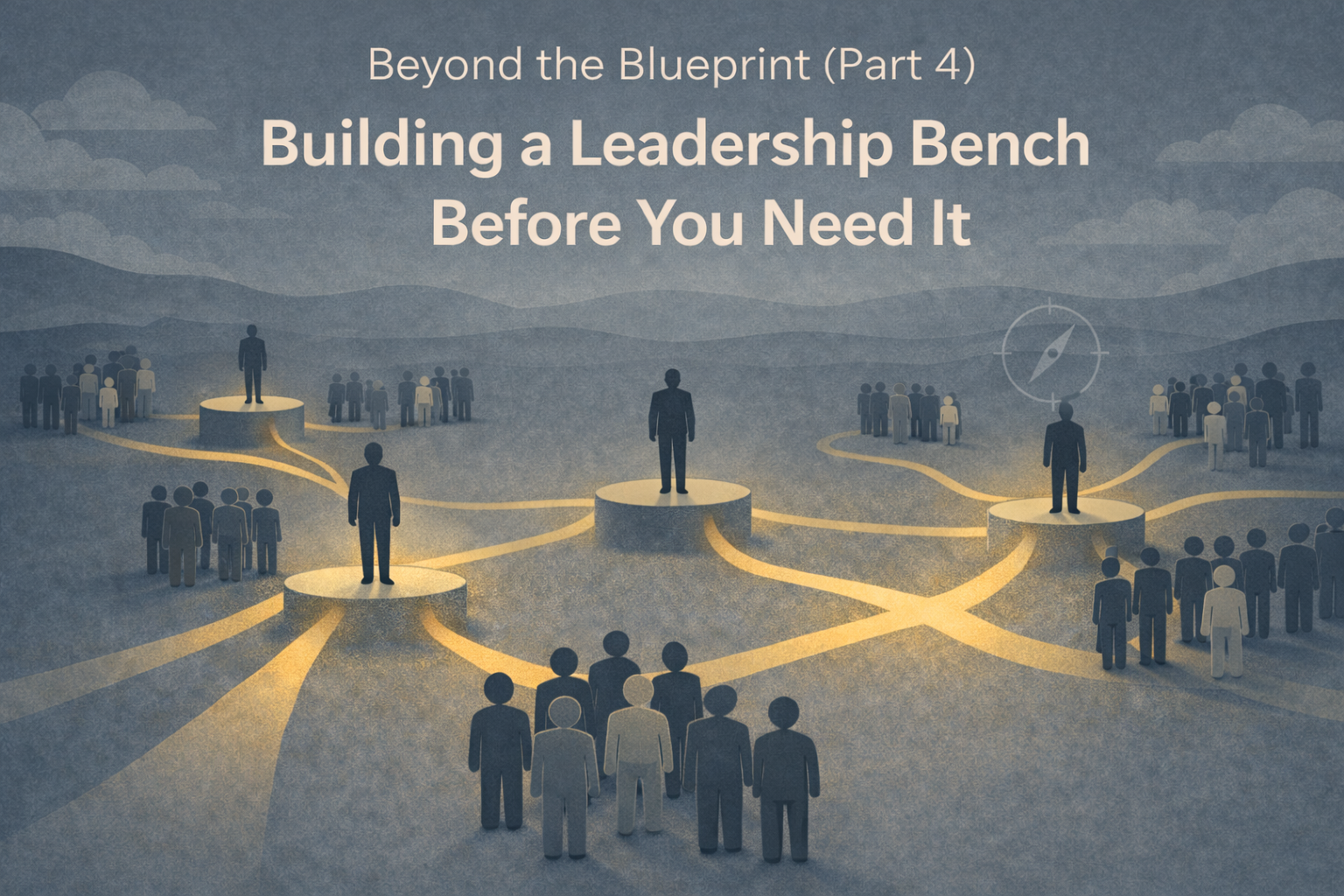
Most leadership teams don’t realize they have a leadership bench problem until growth starts to hurt.
Decisions slow.
Leaders get pulled back into the weeds.
High performers stall or burn out.
At that point, the instinct is reactive:
-
Promote someone quickly
-
Hire externally
-
Add another layer
But leadership benches aren’t built in moments of urgency.
They’re built before demand shows up.
Why Leadership Benches Are Always Late
Leadership benches are often treated like succession plans:
But a leadership bench isn’t about replacing people.
It’s about ensuring the organization can absorb growth, complexity, and change without slowing down.
By the time leaders feel the bottleneck:
-
Decision load is already concentrated
-
Trust hasn’t been distributed
-
Judgment hasn’t been developed
Which means leaders are trying to build capacity while already constrained.
That rarely works.
A Leadership Bench Is About Decision Readiness, Not Titles
A common misconception is that a leadership bench equals:
In reality, a leadership bench exists when:
-
Decisions can be made at the right level
-
Ownership is clear and respected
-
Leaders don’t need to be present for progress to continue
That has far less to do with hierarchy—and far more to do with modeled behavior and judgment.
A bench isn’t visible on an org chart.
It’s visible in how work moves when leaders step away.
What Strong Leadership Benches Have in Common
Organizations with effective leadership benches share a few characteristics:
1. Decision rights are explicit
People know:
-
What they can decide
-
What they must escalate
-
What outcomes they own
Ambiguity is the enemy of capacity.
2. Judgment is developed, not assumed
Leaders don’t just delegate tasks.
They model how decisions are made:
This is how judgment scales.
3. Leaders create space for others to lead
This is the hardest part.
Building a bench requires leaders to:
-
Resist stepping in too quickly
-
Allow productive struggle
-
Let others make decisions—and learn from them
Without this space, leadership capacity never transfers.
Why Waiting Creates Fragility
When leadership benches aren’t built intentionally:
-
Organizations rely on a few individuals
-
Execution becomes personality-dependent
-
Growth increases risk instead of resilience
This is why some businesses look successful—but are brittle.
They work until a leader leaves, burns out, or becomes unavailable.
Then everything slows.
Leadership Benches Are a Strategic Asset
Organizations that treat leadership bench strength as a strategic asset—not a development program—experience:
The business doesn’t just scale.
It stabilizes.
What Comes Next
In Part 5 of Beyond the Blueprint, we’ll connect leadership bench strength directly to execution and cost:
Why leadership capacity is one of the most overlooked drivers of operational efficiency—and why cost reduction efforts fail without it.
📅 [Schedule a Strategy Alignment Session]
If your organization feels successful but fragile, let’s assess whether leadership bench strength—not strategy—is the missing layer.