Most organizations know when a hire isn't working.
They can see:
- Performance issues
- Communication problems
- Lack of accountability
- Leadership struggles
- Team friction
The challenge is that these problems usually appear after the hiring decision has already been made.
By then, the cost is already being paid.
So the real question becomes:
What should we be looking for before we hire?
The Missing Definition
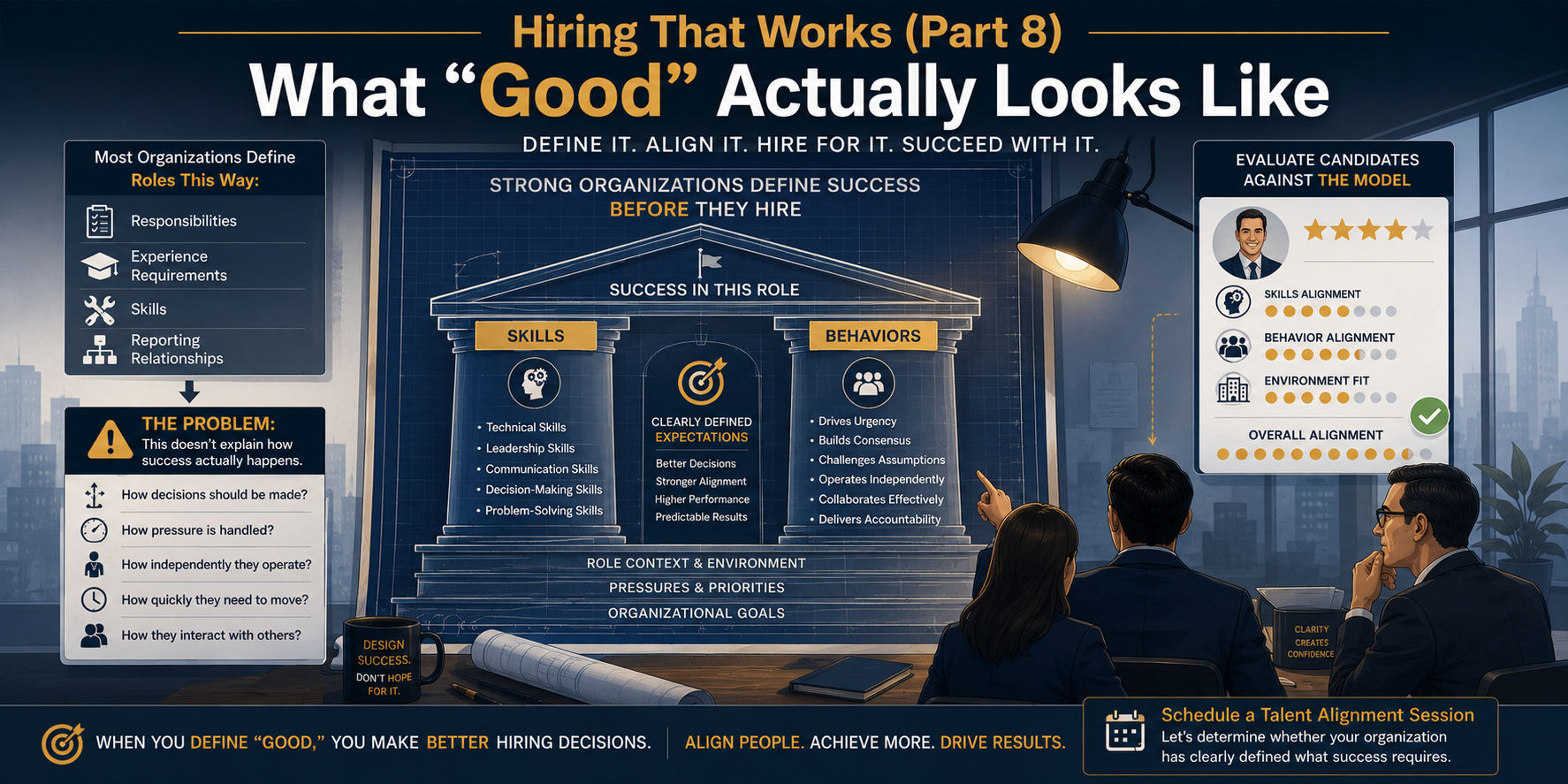
Most organizations define roles using:
- Responsibilities
- Experience requirements
- Skills
- Reporting relationships
Those things matter.
But they don't explain how success actually happens.
They don't tell you:
- How decisions should be made
- How pressure should be handled
- How independently someone should operate
- How quickly they need to move
- How they should interact with others
Yet those factors often determine success more than experience alone.
What Strong Organizations Define
Before evaluating candidates, strong organizations define:
Skills
What capabilities are required?
Not just technical skills, but:
- Leadership skills
- Communication skills
- Decision-making skills
- Problem-solving skills
Behaviors
How must the role operate?
For example:
Should this person:
- Drive urgency?
- Build consensus?
- Follow established processes?
- Challenge assumptions?
- Work independently?
- Collaborate extensively?
Different roles require different answers.
Why This Matters
When skills and behaviors are clearly defined:
- Interviews become more focused
- Hiring decisions become more consistent
- Promotions become more predictable
- Expectations become clearer
- Performance becomes easier to manage
Because everyone is working from the same definition of success.
The Difference Between Hope and Design
Many organizations hire based on hope.
They hope:
- The person adapts
- The team aligns
- Expectations become clear
- Performance improves
Strong organizations don't rely on hope.
They design for success.
They define it before the search begins.
The Real Goal
The goal isn't to find the perfect person.
The goal is to clearly define what success requires – and then find someone who aligns with it.
When that happens:
Hiring becomes less subjective.
Promotions become less risky.
And organizational performance becomes far more predictable.
Final Thought
Most hiring problems don't start with candidates.
They start with unclear definitions of success.
The stronger the definition, the stronger the decision.
📅 [Schedule a Talent Alignment Session]
Let's determine whether your organization has clearly defined what success actually requires.